Get Full Government Meeting Transcripts, Videos, & Alerts Forever!
Get email alerts on the Audit topic
No spam. Unsubscribe anytime.
Princeton accepts FY2025 audit after review of fund balances, repeat findings
Summary
The Princeton Board of Commissioners accepted the town—s fiscal year 2025 audit 4-0 after auditor Austin Eubanks summarized a positive operating change, several repeat findings (donor-restricted funds and budget noncompliance), and recommendations to improve reconciliations and budget authorizations.
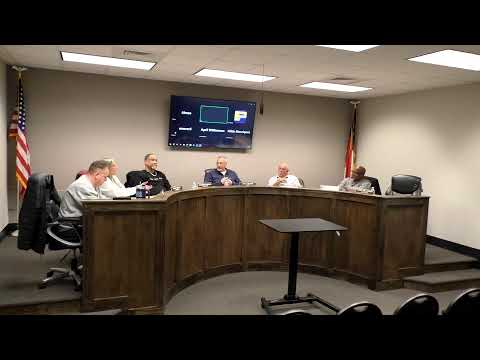
The Princeton Board of Commissioners voted unanimously Feb. 2 to accept the town—s fiscal year 2025 audit after an hour-long presentation by Austin Eubanks, audit manager with ThompsonPrice.
Eubanks said the town—s financial statements showed total revenues of about $1,723,000 and total expenditures of about $1,600,000, producing a roughly $115,000 positive net change for the year. "Your unassigned fund balance was 601,000, and that puts you above that threshold of 34% right at 38.15%," Eubanks said, noting that the ratio gives the town roughly four and a half months of operating capacity.
The auditor identified repeated internal-control findings and compliance issues. He said the town has a repeat finding related to donor-restricted (Golden Leaf) funds that the report concluded did not meet the referenced statutory requirements and remains on the town—s repeated findings list. Eubanks also reported budget noncompliance in several funds, including the Golden Leaf drainage fund, the community building project fund, street paving project fund and certain water/sewer project funds, where expenditures were recorded without formal budget appropriations.
Eubanks recommended routine monthly reconciliations of significant accounts, particularly credit-card statements, and stronger documentation for receipts and supervisory review. He flagged a late submission of a Local Government Commission report, which he described as a statutory violation under the statute cited in the audit, and urged staff to calendar required report dates to avoid future late filings.
After the presentation, a commissioner moved to accept the audit; the board seconded the motion and the chair announced the vote passed 4-0. The board asked staff to distribute the auditor—s presentation and to return any required corrective-action responses within the agency portal as recommended.
The town accepted the audit formally; the board also recorded minor corrections to the prior-meeting minutes during the same meeting. The auditor said he found no evidence of irregularities or illegal acts during the fieldwork, but reiterated the need to resolve recurring control weaknesses and to adopt documented budget authorizations for multi-year projects.