
Maryland panel hears industry and regulator briefing on autonomous vehicles; lawmakers press on safety, liability and cyberrisk
Get AI-powered insights, summaries, and transcripts
Subscribe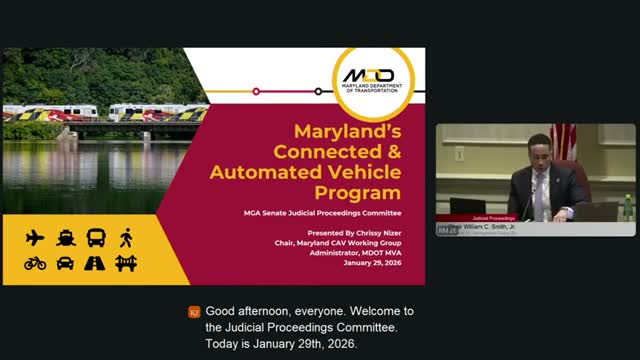
Summary
Maryland regulators, Waymo and industry representatives briefed the Judicial Proceedings Committee on Jan. 29 about testing permits, safety data and operational models for autonomous vehicles; lawmakers pressed witnesses on a school-bus inquiry, cybersecurity, remote operators and how liability and fees would be handled under future legislation.
Annapolis — Lawmakers pressed industry and state officials on Jan. 29 over how autonomous vehicles are tested, monitored and insured as the Judicial Proceedings Committee heard a bipartisan briefing on the technology that companies say can reduce crashes but that some legislators say raises questions about liability, cybersecurity and workforce impacts.
Maryland Motor Vehicle Administration Administrator Christy Neisser told the committee the state has run a connected and automated vehicle working group for more than a decade and created a highly automated vehicle permit process in 2017 to authorize testing. "Safety is right at the heart of it," Neisser said, describing a staged permitting approach that requires applicants to submit documentation, insurance proof and undergo hands-on inspections with the Maryland State Police safety inspection unit before vehicles are allowed to operate beyond closed testing.
Neisser said the program has drawn 52 expressions of interest from research institutions and private companies and that the administration shares testing information with local law enforcement and conducts public outreach in the communities where pilots run. She added that Maryland’s current administrative authority covers testing but that any move to broad commercial deployment "would require additional legislative authority." The administrator said Maryland is coordinating with the Maryland Insurance Administration on insurance and liability planning.
Waymo’s northeast policy manager Anthony Perez told the committee Waymo’s vehicles operate with a human remote-safety operator during current tests and that the company’s sensors and software have driven hundreds of millions of miles in aggregate. Perez said Waymo’s internal safety analysis shows reductions in serious-injury crashes compared with average human drivers and that the firm publishes safety data at waymo.com/safety. "We operate at level 4, which means it's true autonomy, where an empty vehicle can pick you up and transport you door to door," Perez said, adding Waymo’s fleet is electric and that the company uses remote assist when a vehicle needs a confirmatory, human-led yes/no decision.
Industry testimony from Ariel Wolf, general counsel to the Autonomous Vehicle Industry Association, emphasized the split in U.S. authority: the federal government regulates vehicle design and safety standards while states regulate operations, licensing, registration and insurance. Wolf noted that model deployment legislation has been enacted in many states and urged continued work on national crash reporting and first-responder interaction protocols.
Several lawmakers challenged witnesses on recent safety and operational concerns. Senators asked about a Washington Post report and an NTSB inquiry into Waymo conduct near school buses; Perez said the company reported a Santa Monica incident to NHTSA in which the vehicle slowed from 17 mph to 6 mph after a child emerged from behind a parked SUV and that the child was not directly injured. Perez said Waymo issued a software update and a recall to improve school-bus arm recognition after related Austin incidents and that the company will cooperate with investigators.
Other lawmakers sought details on cybersecurity and remote updates after hearing that companies can push software changes to their fleets. Perez and Wolf said autonomous vehicles are designed with cybersecurity protections and that industry and federal information-sharing mechanisms exist, but both witnesses acknowledged no system is entirely immune to hacking. Committee members also pressed Waymo on the location of remote-assist operators; Perez said operators can be distributed domestically and internationally to provide 24/7 response but stressed that remote assist is not remote piloting — it is a confirmatory process rather than direct control of steering or acceleration.
Lawmakers also pressed witnesses on liability and insurance questions. Industry witnesses said that under current law a human operator remains responsible for a vehicle; model legislation enacted in some states treats the automated driving system (ADS) as the driver for traffic-law compliance, which would shift liability to deployers or operators. Neisser said Maryland does not have statutory authority for widespread deployment and that additional legislative action would be needed to change liability rules or to authorize new fee structures for permits.
Economic and workforce impacts were a recurring theme. Senators sought city-level employment and revenue data from Waymo; Perez said the company would provide figures but argued that AV deployments create supporting jobs (mechanics, fleet operators, dispatchers) and can increase local economic activity by connecting riders to businesses and events.
On data and privacy, Waymo said telematics and sensor data are used for safety and reporting, microphones are not used to record conversations during rides, and reported data is anonymized for reporting purposes. Neisser said permits require submission of reports and that the administration has received data from past permit operations, though she noted no currently active permits at the time of her testimony.
The briefing produced no formal votes. Chair Smith said the committee will use the briefing to inform legislative discussions this session and thanked witnesses for their time.
The committee asked for follow-up material, including city-level employment and revenue numbers from Waymo, more detail on where remote-assist operators are based, and more information about intellectual-property and data-sharing arrangements. The committee adjourned without taking action on legislation.