Get AI Briefings, Transcripts & Alerts on Local & National Government Meetings — Forever.
Tourism industry lawyer briefs Austin commission on strict rules for hotel-occupancy tax and how TPID funding works
Loading...
Summary
Scott Joslav of the Texas Hotel and Lodging Association told the Austin Tourism Commission that Texas law requires every local hotel-occupancy tax expenditure to "directly promote" tourism and the hotel/convention industry and described the allowed statutory categories and how Austin27s new Tourism Public Improvement District (TPID) is structured.
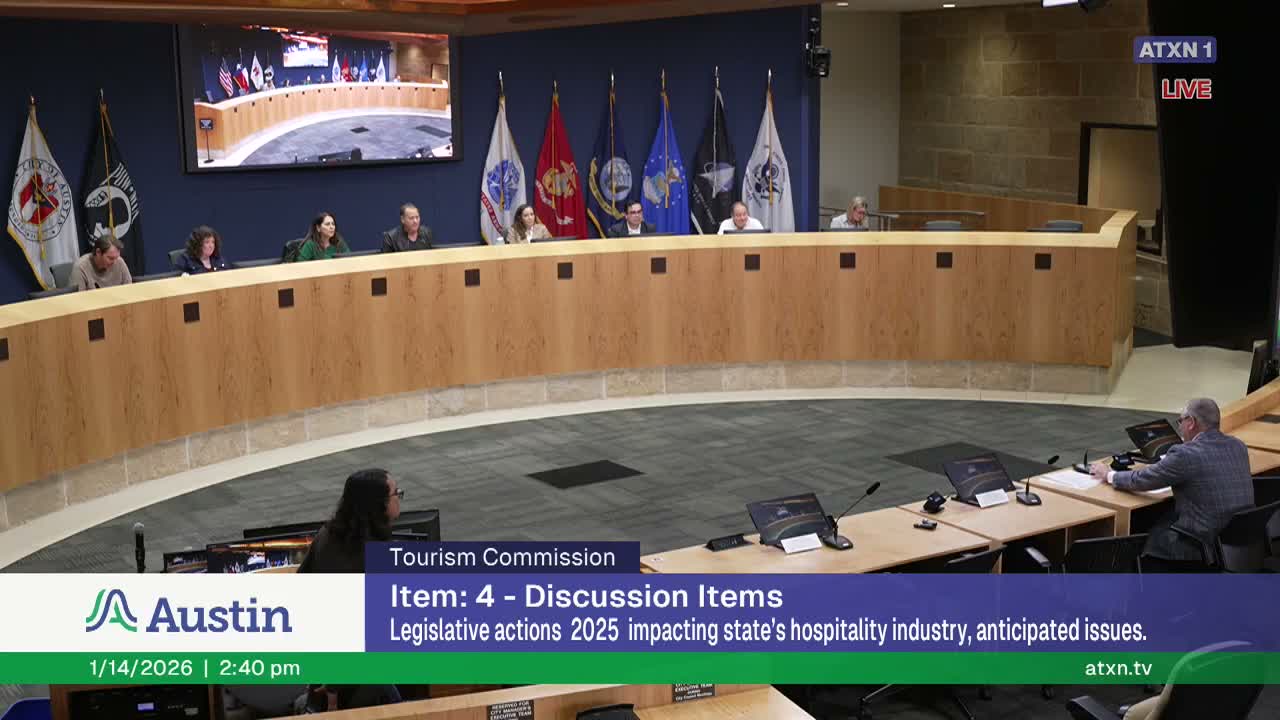
Scott Joslav, president and senior counsel for the Texas Hotel and Lodging Association, told the Austin Tourism Commission on Jan. 14 that Texas law imposes a strict two-part test on how cities may spend local hotel-occupancy tax money.
"Every expenditure must directly promote tourism and the convention and hotel industry," Joslav said, describing the requirement in chapter 3 51 of the tax code as mandatory rather than aspirational. That requirement, he said, means the city must show that, but for the funded improvement or program, the visitor would not likely have come as a tourist or a hotel guest.
The second part of the test is categorical: expenditures must fall into one of the statute27s allowable categories. Joslav ran through the seven categories that apply to Austin, including convention centers (with a primary-usage test and city-ownership or city-management requirement), registration and convention-delegate services, advertising and promotion (the only mandatory category), promotion of the arts, historical restoration and preservation, transportation/shuttles that move tourists to attractions, and directional signage.
Joslav emphasized a few operational limits frequently asked about in Austin:
- Parking paid from hotel-tax funds is allowable only when it is within 1,500 feet of a qualifying convention facility; qualified convention-center hotels may be eligible if within roughly 1,000 feet. - Marketing is the statutory floor: jurisdictions must spend about one-seventh (roughly 142526ndash;1525) of hotel-tax receipts on advertising and promotion; jurisdictions commonly spend more. - Arts and historic-restoration categories are capped at 1525 of hotel-tax receipts each; arts expenditures must also demonstrate an effect on hotel and convention business. - Park projects and general city operations are not an allowable use under current law, and attempts to broaden the law in past legislative sessions have failed.
Commissioners asked how public art such as murals would be treated. "Murals are considered an art form," Joslav said, and public art that is accessible to tourists and hotel guests typically qualifies under the arts category; programs limited to school-only audiences generally do not.
Joslav also reviewed the venue-tax and county propositions that can add an extra 225 for venue projects under a separate statute (chapter 3 34), and he explained why "sporting-related events" and "sporting-related facilities" are limited under current law to certain jurisdictions (population and county thresholds), making them generally unavailable to Austin under present statutes.
On the Tourism Public Improvement District (TPID), Joslav described the statutory framework (identified in the presentation as chapter 372 of the local government code): TPIDs are funded by assessments on hotels (Austin27s assessment targets hotels with 100 or more rooms), operate under a 10-year service plan, and restrict the use of TPID funds to sales and marketing (typical allocations cited were 4525 marketing, 4525 sales and the remainder for research and administration, though local service plans may vary). He credited Dallas27s TPID results for large gains in event wins and occupancy and said the TPID board27s ROI standards (for example, 7:1 to 10:1 room-night returns per dollar of incentive) drive project choices and timing.
Joslav noted the Austin TPID has been in operation since about 2023, produces quarterly reports and annual audits that are subject to public records, and has been used to support major citywide events and targeted campaigns while the convention center is closed. He encouraged the commission to provide service-plan recommendations and said the hotel industry and the municipal-league counsel commonly review borderline legal issues together before advising communities.
The presentation concluded with a look ahead to legislative priorities Joslav expects the hotel industry to monitor: project-financing-zone authority, qualified-hotel-project provisions, event-trust programs, and clarification bills such as those outlining hotel rights for trespass removal.
The commission followed with detailed questions about how TPID dollars are allocated when the convention center is closed, examples of sales incentives, and the availability of TPID performance data.
The commission asked Joslav to return for follow-ups and thanked him for the briefing. The commission then moved on to schedule items and other business.