Community Behavioral Health Association urges Maryland not to delay CCBHC demonstration, requests $6 million bridge funding
Loading...
Summary
Nicole Greiner of the Community Behavioral Health Association told the Finance Committee the CCBHC model is evidence-based and that delaying Maryland’s demonstration application from FY26 to FY29 would risk rollback of access gains; she requested $6,000,000 in bridge funding to preserve capacity.
Nicole Greiner, director of government affairs and public policy for the Community Behavioral Health Association of Maryland (CBH), told the committee the CCBHC model is federally defined, accountable, and already producing measurable outcomes in Maryland and nationally.
"These providers have been operating under the CCBHC model for nearly a decade with the first CCBHC expansion grants beginning in 2018," Greiner said, underscoring that Maryland grantees are functioning clinics delivering measurable results.
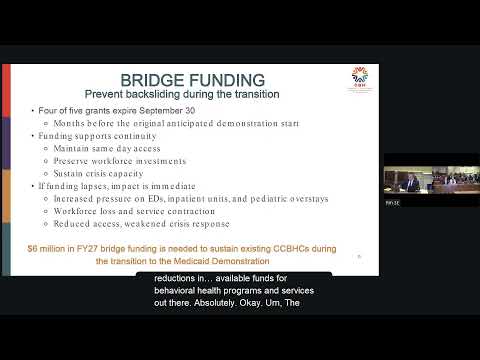
Greiner warned that proposed budget language shifting Maryland’s obligation to apply from "shall" to "may" and delaying a demonstration application from FY26 to FY29 "is not a technical adjustment" and "materially alters Maryland's trajectory and will have significant consequences." She said four of five Maryland expansion grants expire in September 2026 and that grant dollars currently support services that Medicaid does not reimburse, including multi-language medical translation, embedded nursing in residential programs, benefits counseling, expanded care coordination and peer support.
CBH asked for a limited financial bridge to preserve capacity while the state completes planning and moves toward the demonstration: "What is being asked for is not immediate statewide expansion... $6,000,000 in bridge funding to to preserve existing CCBHC capacity and continued legislative oversight," Greiner told the committee.
Greiner added that the demonstration does not require immediate statewide expansion; rather, it creates a predictable funding framework and an enhanced federal match (65%) that can lower state share when structured correctly. She urged the committee to ensure cost assumptions reflect the full scope of CCBHC services rather than a narrow clinic-only cost model.