
Maryland health officials brief Finance Committee on CCBHC planning, seek more time to finish requirements
Get AI-powered insights, summaries, and transcripts
Subscribe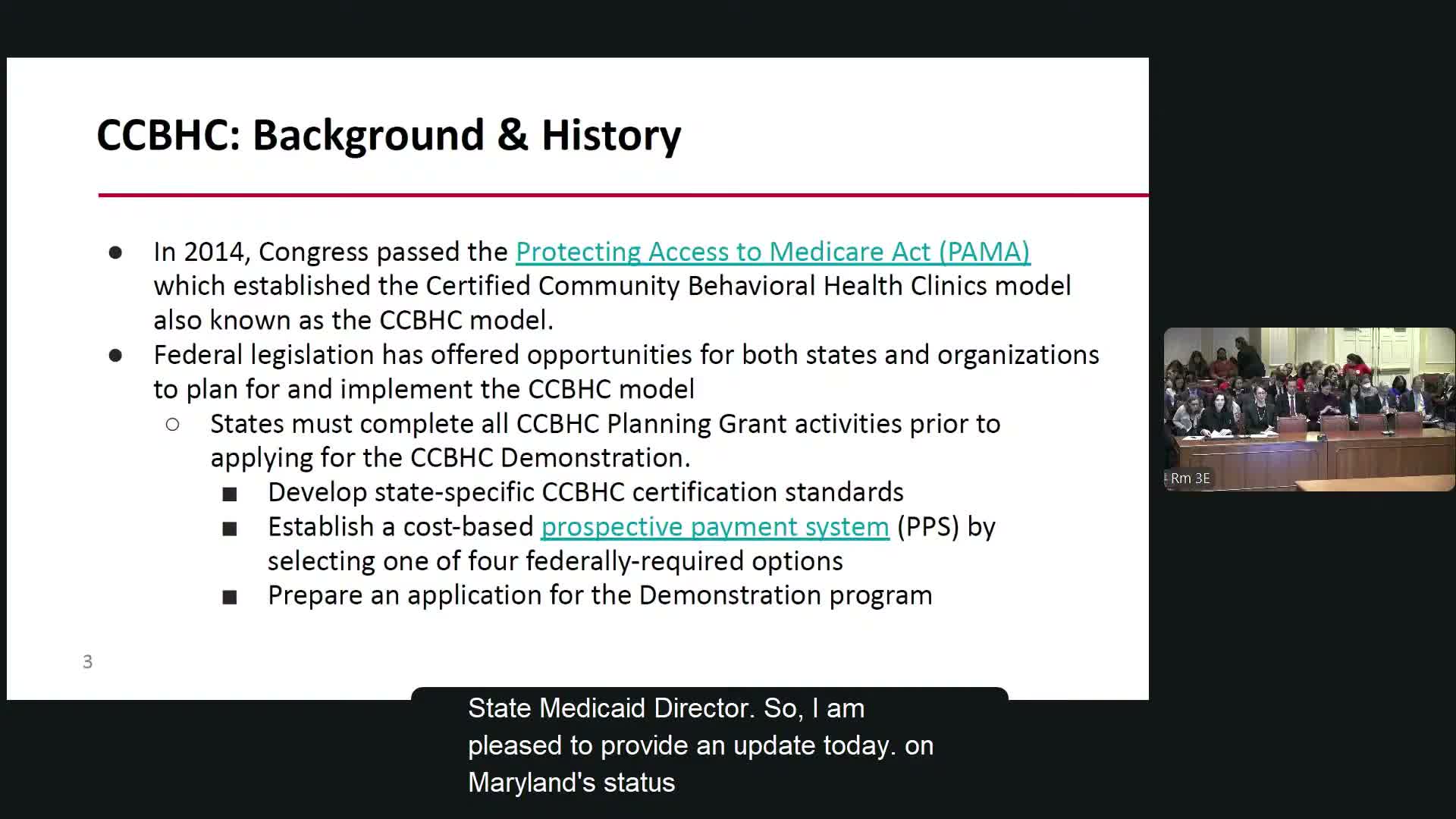
Summary
Maryland Department of Health told the Senate Finance Committee it received a SAMHSA planning grant in December 2024, has secured a no-cost extension, and is seeking more time to complete cost reporting and certification standards before applying for the CCBHC demonstration; MDH estimates $13–$15 million to implement two CCBHCs.
At a Finance Committee briefing, Maryland Department of Health deputy secretaries Alyssa Lohr and Perry Briskin outlined the state’s work to prepare for a certified community behavioral health clinic (CCBHC) demonstration and said the department is seeking additional time to complete planning activities.
"We were awarded the planning grant in December 2024," Lohr told the committee, describing partnerships with the Mental Health Association of Maryland and Myers & Stauffer to support stakeholder engagement and cost reporting that will underpin a prospective payment system (PPS).
Why it matters: The CCBHC demonstration would allow Maryland to replace temporary grant funding with a bundled, prospective payment that better funds care teams for people with serious mental illness and substance use disorders, and it carries an enhanced federal Medicaid match (MDH cited a 65% FMAP tied to the demonstration).
MDH said it had applied for and received a SAMHSA no-cost extension "just this past December, December 24 to be exact," giving the department additional time to complete planning activities and finalize certification criteria. The department also flagged uncertainty at the federal level—including the timing of SAMHSA demonstration solicitations and possible federal funding disruptions—as a reason for seeking flexibility in timetable.
Cost and timing: MDH presented a planning estimate "it's looking at that $13,000,000 in total funds" and said implementation for two CCBHCs could be in the $13–$15 million range. Officials described the work remaining: completing cost reporting, certifying standards, identifying two CCBHCs (one rural), and building a PPS rate methodology.
What was asked and next steps: Committee members sought clarification on language in a budget bill amendment that would change the state's obligation to apply from "shall" to "may" and would tie application timing to future budget availability. MDH said the change reflects federal uncertainty and an effort to better define Maryland’s model before applying for the demonstration. The department noted a joint chairman’s report (JCR) responding to prior session questions on cost, quality and outcomes is due to the General Assembly on 2026-05-01.
The department emphasized continuity of care for current clients if the state delays the demonstration application: existing outpatient services would continue to be reimbursed through the public behavioral health system, while the department and providers work on bridge funding and financial modeling.
The committee recessed for a five-minute break and planned to resume with provider testimony.