
CDC outlines immunoassay gaps for fentanyl analogs and urges use of reference materials
Get AI-powered insights, summaries, and transcripts
Subscribe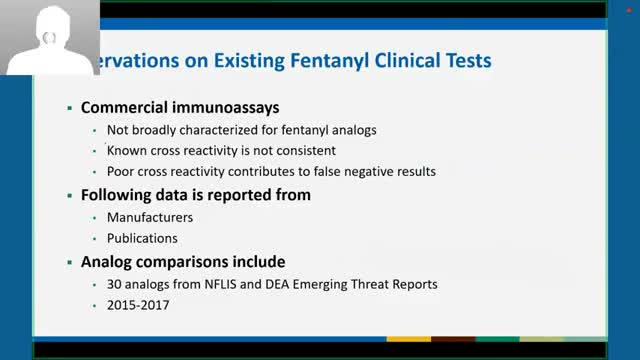
Summary
CDC highlighted that many clinical immunoassays detect fentanyl well but have poor cross-reactivity for certain analog classes (notably structural classes 1 and 2), increasing false-negative risk; the agency recommends use of reference materials and proficiency testing to address gaps.
Dr. Rudolph Johnson of the CDC told webinar attendees that while many clinical immunoassays detect fentanyl itself with high cross-reactivity, detection of numerous fentanyl analogs varies by structural class and can be poor for some classes, creating a risk of false-negative results in clinical and surveillance contexts.
Johnson described a structural-class system developed with Georgia Tech that groups fentanyl derivatives into eight classes by where substitutions occur on the molecule (head, core, tail, truncated analogs). He summarized cross-reactivity observations: high cross-reactivity for fentanyl (Class 0) and generally good performance for classes 3to4, but markedly poorer cross-reactivity in classes 1 and 2 and very low performance for truncated analogs (Class 7). "If there is an emerging fentanyl and it comes out and it has a substitution similar in the 1 or 2 category, we should be concerned for false negatives," Johnson said.
To address those gaps, Johnson said CDC is distributing reference materials that laboratories can use to evaluate and characterize immunoassays and screening kits; he described plans to share primary spectra for high-resolution instruments and to collaborate with manufacturers and the private sector so companies may improve kit cross-reactivity voluntarily. He emphasized CDC does not produce final commercial immunoassay kits but can provide materials that may prompt improvements: "We anticipate if you share these materials with the private sector, some of the companies will make the step forward to improve their kits, nothing we can require, but we anticipate that happening."
Johnson also said CDC will develop more generic clinical testing methods and proficiency testing to help laboratories measure a broader set of fentanyl analogs, and encouraged labs to provide feedback on observed gaps in specific classes so CDC and partners can prioritize antibody development and database improvements.
The presenter cautioned that the materials and methods are focused on clinical testing (blood and urine), not environmental testing, and reiterated safety and training for handling fentanyl reference materials.
The webinar Q&A included technical questions about Orbitrap and QTOF high-resolution instruments, and Dr. Johnson recommended careful calibration and vendor consultation when adapting screening kits or glycerin-formatted standards to specific instrument platforms.