Get Full Government Meeting Transcripts, Videos, & Alerts Forever!
Get email alerts on the Reference Materials topic
No spam. Unsubscribe anytime.
CDC offers free reference-material kits to U.S. labs to improve fentanyl testing
Summary
CDC announced commercially contracted traceable opioid material kits—certified reference materials and screening kits—will be available at no cost to U.S. laboratories with DEA registration to improve consistency, surveillance and proficiency in detecting synthetic opioids.
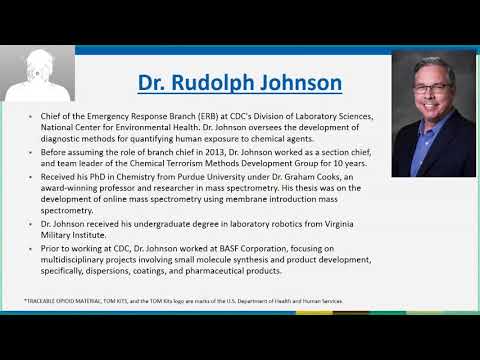
Dr. Rudolph Johnson, chief of the Emergency Response Branch at the Centers for Disease Control and Prevention(CDC), said on a hosted RTI International webinar that CDC has contracted for "traceable opioid material" kits to help laboratories detect synthetic fentanyl and related compounds more consistently.
The kits come in two types: certified reference materials (CRMs) intended for routine quantitative testing with matched heavy-isotope internal standards, and screening kits (96-well format) designed for building spectral libraries and screening immunoassays. "We have contracted the traceable opioid material kits," Johnson said, adding the CRM contract includes 16 fentanyl analogs that, by case counts, cover about "99 percent of the DEA emerging threat report." Third-party conformity assessments for kit contents are being performed by Battelle and will be posted by the vendor, Johnson said.
CDC said the kits are available at no cost to public, private and academic laboratories located in the United States that hold a current DEA controlled-substance registration and comply with state and local regulations. Ordering goes through contractors (CDC named Cerulean for the CRM kit and Cayman for the screening kits); CDC staff asked laboratories not to contact the agency directly to acquire kits. Dr. Johnson emphasized the kits are not themselves diagnostic approvals: "Only the FDA can convey approval to use a method...Using these contracted kits with CDC does not alleviate the need to get FDA approval."
Johnson said the screening kits include roughly 150 fentanyl analogs supplied at about 200 micrograms each in 2 microliters of glycerin and are limited-production; CRMs include matched carbon-13 and nitrogen-15 internal standards for quantitative work. CDC plans to pilot a proficiency-testing program this year using the CRM kit as the model and expand the program next year to assess labs' ability to measure low-concentration synthetic opioids.
The goal of the initiative, Johnson said, is to reduce a key barrierlack of readily accessible reference materialsand to promote method consistency across clinical, public health and academic laboratories. He encouraged laboratories that have technical questions about using or developing methods based on the materials to contact him directly and to direct ordering and acquisition questions to the named contractors.
The webinar host noted a PDF of the slide deck and the recorded archival version will be posted to the webinar page, and posted Dr. Johnson's contact (Rmj6@cdc.gov) in the chat for follow-up.
The immediate next steps Johnson outlined were distribution of the contracted kits to eligible U.S. labs, a pilot proficiency test using the CRM set this year, and ongoing updates to kit composition as new compounds emerge.