Get Full Government Meeting Transcripts, Videos, & Alerts Forever!
Get email alerts on the Forensic Nursing topic
No spam. Unsubscribe anytime.
Forensic nursing specialty matures as educators push LACE standards and new certification pathways
Summary
In an RTI FTCOE webinar, Dr. Pat Speck and Diana Fagno traced forensic nursing’s history, urged evidence-based practice and trauma-informed care, and outlined LACE (Licensure, Accreditation, Certification, Education) and a planned certification expected in 2020; speakers also flagged workforce shortages and local implementation steps.
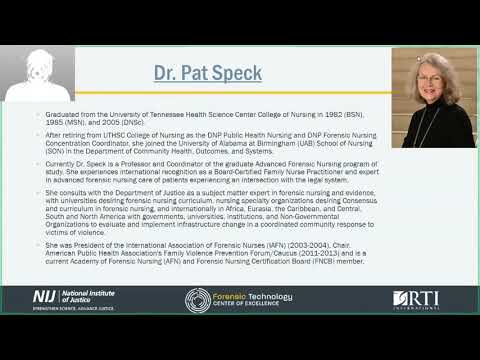
Dr. Pat Speck, a professor and coordinator of the graduate advanced forensic nursing program at the University of Alabama at Birmingham, and Diana Fagno, president of the Academy of Forensic Nursing, outlined the development and future of forensic nursing during a recorded RTI International Forensic Technology Center of Excellence webinar.
Speck opened by placing forensic nursing in historical context, saying the specialty unites nursing, forensic science and legal science and that early professional work by researchers like Virginia Lynch framed the field. "I would suspect that Diana and I together have seen close to, I don't know, maybe 75,000 patients over our careers," Speck said, using her clinical experience to illustrate the scope of patient encounters that inform practice and education.
Why it matters: Speakers argued that forensic nursing now requires clearer educational pathways and standardized professional recognition because the discipline touches many patients who intersect with legal systems — from sexual assault and child abuse to elder neglect and corrections healthcare. Speck noted research advances in the 2000s and 2010s changed clinical evidence-collection practices and DNA-sampling timing, strengthening the case for standards.
Key developments: The presenters described how a 1990s consensus around the Lynch framework led to specialty recognition and curriculum work. Speck summarized the LACE model — Licensure, Accreditation, Certification and Education — as the academy’s roadmap for achieving consensus and specialty standards. "It has no effect on you at all," Speck said in response to an attendee asking whether LACE would change bedside RN practice; she clarified that bedside nurses would continue providing care while LACE addresses advanced-practice standardization and formal specialty pathways.
Workforce and implementation: Diana Fagno emphasized a pressing workforce need: "We need more forensic nurses," she said, and described a small California hospital that added 24/7 forensic nursing coverage to identify cases and improve care. Both presenters urged hospitals, accrediting bodies and educators to adopt policies and job descriptions that recognize forensic nursing roles beyond SANE (Sexual Assault Nurse Examiner) duties.
Certification and timelines: Speakers discussed ongoing professional-development work. Speck said a forensic nurse certification board is developing examinations and study materials, with study text expected by the end of the year and first certifications projected in 2020. She also explained that prior ANCC portfolio certifications were phased out and that the discipline is working toward internal certification structures.
Practical advice for nurses and programs: Presenters recommended aligning continuing education and organizational support with career goals, integrating forensic content into basic nursing curricula, and establishing clear policies for multidisciplinary teams (SARTs) about records access, HIPAA and electronic discovery. They encouraged clinicians to join professional organizations — including the newly formed Academy of Forensic Nursing — to shape standards and training.
What’s next: Presenters said the field will continue to borrow and adapt methods from nursing science, forensics and legal domains, and they urged a research agenda to close gaps in practice. The webinar host noted the session was recorded and that presentation materials and a survey were posted in the chat for attendees.
The webinar closed with resources posted to the FTCOE site and an invitation for nurses and educators to participate in consensus and certification efforts.