
RTI webinar: Forensic nurse details how trauma alters the brain, memory, and recovery
Get AI-powered insights, summaries, and transcripts
Sign Up Free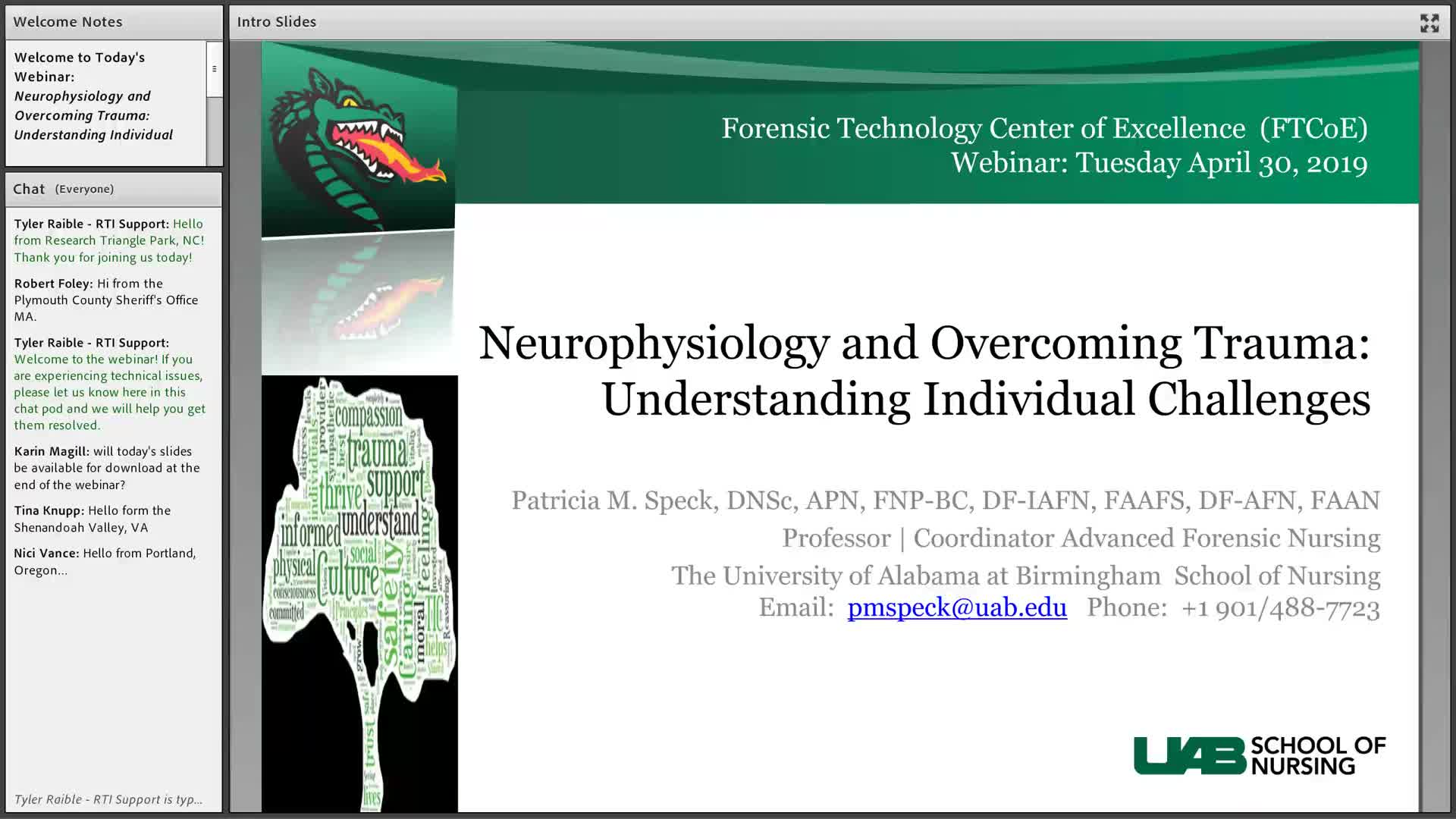
Summary
Dr. Patricia Speck, speaking in an RTI International Forensic Technology Center webinar, summarized research on stress physiology, memory disruption after trauma, epigenetic effects across generations, and clinical practices (e.g., journaling, recovery time) to support survivors. The webinar included historical and epidemiologic examples and a DOJ disclaimer.
Dr. Patricia Speck, a professor and coordinator of the graduate advanced forensic nursing program at the University of Alabama at Birmingham School of Nursing, outlined how trauma changes brain function and complicates memory and recovery during a webinar hosted by the Forensic Technology Center of Excellence at RTI International.
Speck framed the talk around Selye's stress theory and the general adaptation syndrome—alarm, resistance and exhaustion—explaining that acute alarm launches the hypothalamic–pituitary–adrenal (HPA) axis and releases hormones such as ACTH, cortisol and adrenaline that provide immediate energy but, when repeatedly activated, can damage cells and organs. "Cortisol can make it difficult to think and retrieve even long term memories," Speck said, noting that chronic stress is associated with cardiovascular disease, stroke risk and cognitive impairment.
Speck described concrete clinical implications: short-term memory is often the first casualty of traumatic stress, survivors may have fragmented or delayed recall, and immediate expectations that victims "say everything immediately" can be unrealistic. "Why is a victim expected to say everything immediately?" she asked, urging clinicians and investigators to allow recovery time and use tools such as journaling to help survivors reconstruct memories incrementally.
Drawing on epidemiologic studies discussed in the webinar, Speck said sexual-assault survivors have higher rates of PTSD and related sequelae—depression, alcoholism and injury—than some other survivor groups. She cautioned that outcomes worsen for individuals who receive few services or who are revictimized.
Speck also summarized evidence and theory about intergenerational effects: animal studies and human research suggest that severe stressors can produce epigenetic changes that influence descendants. She cited the NASA twin study as an illustrative example, saying that one astronaut's DNA markers changed compared with his twin after spaceflight (presenter-stated figure: "17% of his DNA changed"). Speck prefaced that material by acknowledging active scientific debate over genetic and epigenetic interpretations and presented these points as clinical perspective rather than settled mechanistic proof.
The webinar included historical examples (World War II nurses, the Great Depression, internment and other population-level traumas) to show how social context and negative social reactions can compound individual harm. Speck emphasized determinants of traumatic response—age at first trauma, pretrauma functioning, ongoing life chaos, social supports and personality—and how repeated triggering produces a hyperactive sympathetic nervous system that is slow to shut down.
Speck closed by reiterating the presenter's responsibility to bring published evidence to clinicians and by noting the standard webinar disclaimer: the opinions expressed are the speaker's and do not necessarily reflect the U.S. Department of Justice. The presentation recommended trauma-informed practices (allowing recovery time, reflective journaling, attention to developmental timing) while framing many epidemiologic figures and mechanistic claims as literature-based summaries presented by the speaker.
Next steps: the webinar served as an educational briefing; no policy decisions or formal actions were taken during the session. Contact information and citations for the studies referenced were not specified in the webinar recording metadata.