
Violet light significantly increases bruise detection across skin tones, researchers say
Get AI-powered insights, summaries, and transcripts
Subscribe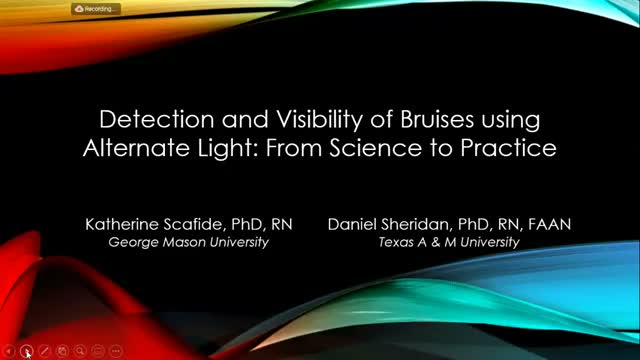
Summary
In an NIJ-funded randomized longitudinal study presented by George Mason and Texas A&M researchers, alternate light at ~415 nm and 450 nm (with yellow/orange filters) substantially increased bruises detected versus white light and produced clinically meaningful visibility gains; authors urged standardized guidelines before routine clinical rollout.
Researchers presenting a webinar hosted by RTI International's Forensic Technology Center of Excellence reported that alternate light sources (ALS) at specific visible wavelengths substantially increase the likelihood of detecting bruises compared with ordinary white light and can improve how clearly bruises are seen across skin colors.
In the presentation, Dr. Catherine Scafidi of George Mason University and Dr. Daniel Sheridan of Texas A&M University described a randomized, longitudinal study funded by the National Institute of Justice that followed experimentally induced bruises on research participants across repeated visits. "The odds of detecting a bruise using 415 nanometers violet light with a yellow filter was 5 times greater than white light," Scafidi said, and she reported a roughly fourfold improvement at 450 nanometers.
Why it matters: bruise detection affects clinical care, evidence collection and legal outcomes, and prior studies were limited by small, nondiverse samples and inconsistent controls. The presenters said ALS can help reduce missed injuries that are less visible under ambient lighting—an outcome that has both medical and forensic importance.
Study design and methods: the team induced bruises on adult volunteers using two controlled methods — a paintball projectile (superficial bruises, mean reported pain ~6.5/10) and a 6-ounce dropped weight (deeper bruises, mean pain ~2.5/10). They enrolled 238 people for prescreening, excluded 74 for medical or other reasons, created bruises on 164 participants, later excluded seven for technical issues, and reported a final analysis sample of 157 participants. Participants were seen in a schedule of up to 21 visits over four weeks; the research team completed 2,903 individual bruise assessments (about 19 per participant) and used a crossover randomized order to compare ALS and white light at each visit.
Measures and equipment: detection (presence/absence) and visibility (a validated 1–5 scale) were the primary outcomes. Skin color was measured objectively with spectrophotometry (L,a,b values) rather than self-reported race. The ALS device used in the study included long-wave UV (365 nm) and narrowband visible wavelengths (approximately 415–535 nm); presenters tested multiple filter combinations and used manufacturer-supplied goggles for observers.
Key findings: modeled results controlling for age, skin color, fat, bruise age and observer indicated large improvements in detection at 415 nm (with a yellow filter, OR ≈ 5.34) and at 450 nm (OR ≈ 4), relative to white light. Scafidi said the 415 nm/yellow-filter combination also produced about a 0.5-point average improvement on the 1–5 visibility scale, which the team considered clinically meaningful. The presenters also reported that ALS detected many bruises several weeks after injury (they cited approximately 82% visibility at the final 4-week visit for the upper-arm results shown).
Caveats and limitations: the presenters cautioned that ALS is not a diagnostic test. Scafidi said absorption under ALS can be mimicked by topical skin products and other lesions, so ALS findings must be corroborated with history and clinical assessment. Observers were not blinded to the bruise location (practical constraints), the sample skewed young and predominantly female (university sampling), and the lower-arm drop-weight method produced less-consistent bruises. The team also noted variability in goggles and filter colors across manufacturers and that infrared had not proven effective in prior work.
Practical recommendations: presenters recommended considering wavelengths near 415 and 450 nm with yellow or orange filters for clinical ALS use, and noted that lower-cost wavelength-specific flashlights may be an acceptable option when budgets prohibit full-featured units. They advised clinicians to document and, if appropriate, collect fluorescing material before cleansing a skin site; presenters said baby/patient wipes were effective in removing many topical mimics and suggested swabbing before washing when trace evidence is possible. On UV use, Scafidi cautioned: "The UV seemed to work with older bruises, but we would caution you to not use UV with... individuals with dark skin," because melanin absorbs UV strongly and can obscure findings.
Implementation and next steps: both presenters urged interdisciplinary teams (clinicians, pathologists, law enforcement, photographers) to develop standardized clinical practice guidelines, training, and photography protocols before broadly deploying ALS in forensic or clinical settings. They said technical details (camera filters, lens specs) and further analyses will appear in forthcoming publications.
The presenters closed by sharing contact information and a downloadable slide deck; they said the team will publish detailed methods, lens/filter specifications and additional analyses, including longer follow-up data and further validation of the visibility scales.