Get Full Government Meeting Transcripts, Videos, & Alerts Forever!
Get email alerts on the Public Finance Investments topic
No spam. Unsubscribe anytime.
Will County finance committee hears investment review showing strong yields, upcoming maturities
Summary
County finance staff and Stifel presented a portfolio snapshot showing a weighted-average yield near 4.6%, roughly $6 million in annual income from invested reserves, and about $20 million in bonds maturing over the next 12 months; staff said ARPA funds ($~40M undrawn) are parked in money markets to preserve liquidity.
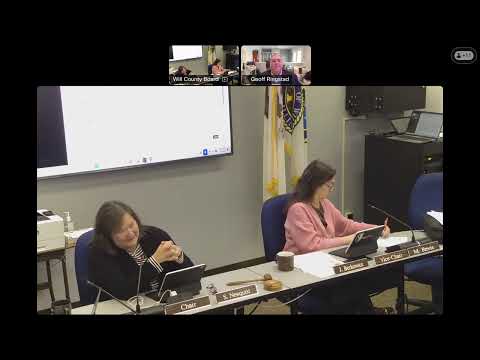
Tim Brophy and outside managers from Stifel briefed the Will County Finance Committee on the county’s investment holdings and near-term cash-management risks.
In a high-level overview, Brophy summarized the county’s structure of corporate funds (used for daily liquidity) and treasurer’s Class C funds (reserved for specific purposes). Stifel’s Jeff Ringstad told the committee their portion of the county’s portfolio is earning a 4.6% weighted-average yield: "Weighted average yield on those funds is 4.6%," he said, noting the county’s portfolios are performing above a peer average.
The nut of the presentation was that the county’s investment program is diversified and heavily government-backed. Ringstad said roughly 98% of the portfolio carries some form of government credit and that the portfolio’s laddering produces predictable cash flows: a large share of principal returns comes in the first five years, with about 75% of the portfolio maturing within that window. Stifel estimated the pooled portfolios generate about $6,000,000 in annual income and produce roughly $1.25 million in outperformance over comparable portfolios.
Committee members pressed staff and Stifel on risk metrics and recent mark-to-market lines in the executive summary. A member asked about a displayed "dollar gain/loss" that showed a negative number on 12/31/2025; Ringstad explained that number is a theoretical market-value metric under a stress scenario, not a realized loss: "That's an estimate. That's a very hypothetical," he said, describing it as a high-level risk-management calculation showing what would happen if rates jumped dramatically in a single day.
Members also asked for detail on a line showing about $20,000,000 in bonds maturing over the next 12 months. Stifel and county staff said maturities are staggered across the year and that the monthly finance packet (and the full board packet) contains a schedule; several members requested that a clear, month-by-month maturities schedule be provided on future finance agendas to help the committee track reinvestment timing and income effects.
The committee also asked where federal relief funds are invested. Brophy said CARES funds have been spent and that ARPA funds are being held in money-market accounts to preserve liquidity because they must be spent by the end of the year; staff said roughly $40,000,000 of ARPA money remained undrawn and was parked in short-term accounts.
Why it matters: the presentation gave committee members context for near-term cash needs (upcoming maturities), how portfolio yields support county operations, and how lower yields on future reinvestments could reduce interest income. Members asked for more granular documentation on maturities and for the monthly finance report to include the securities schedule so reinvestment decisions can be tracked.
The committee thanked the presenters and asked staff to supply the requested schedule and clarifying materials at future meetings.