
Maryland agencies, utilities outline PFAS strategy and warn of high treatment costs for biosolids
Get AI-powered insights, summaries, and transcripts
Subscribe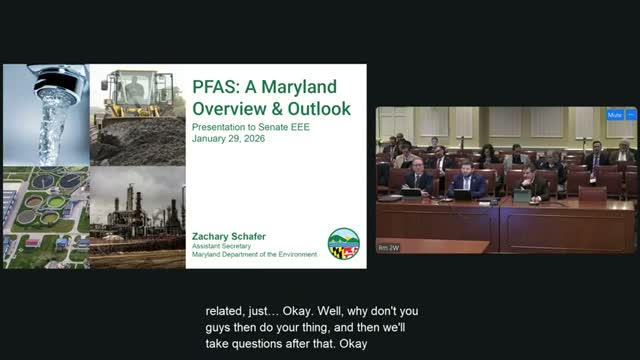
Summary
State and regional officials said Maryland is pursuing source control, pretreatment and litigation to address PFAS but warned that treating or landfilling biosolids at plant scale could cost utilities hundreds of millions and raise rates; MDE pledged technical support for small systems and said more state and federal tools are needed.
Zachary Schafer, assistant secretary at the Maryland Department of the Environment, told the Education, Energy, and the Environment Committee that Maryland is pursuing a three‑part strategy to address per‑ and polyfluoroalkyl substances: prevent releases, reduce high‑risk exposures (drinking water, fish, farms), and hold polluters accountable. "PFAS are a very large family of about 15,000 chemicals," Schafer said, noting they persist in the environment and are found in nearly every American's blood.
Schafer summarized recent state and federal developments, including Maryland's 2023 state action plan and the 2024 state law that required mandatory testing of PFOA and PFOS in biosolids used as fertilizer. He said early state monitoring identified 64 public water systems serving about 200,000 households that are likely to need upgrades to meet federal limits and that MDE has helped nearly half of those systems secure more than $90,000,000 for treatment work. "We are confident that we are on track to ensure that community water systems are in full compliance with the federal rules by the original 2029 deadline," he said, while noting the EPA has signaled it may remove four of six PFAS from the federal rule and has proposed extending the compliance deadline.
On biosolids—the treated sludge often applied as fertilizer—Schafer highlighted an EPA draft risk assessment that found PFOA and PFOS in biosolids can move into dairy, eggs, meat and nearby drinking wells and could raise risks of cancer and other illnesses by substantial margins depending on assumptions. Maryland's 2024 law, he said, established mandatory testing for PFOA and PFOS in biosolids and MDE has issued voluntary guidance recommending reduced use where data show higher levels. "We have nearly 500 samples now from big systems, little systems, rural systems, urban systems," Schafer said, describing the dataset that informs MDE's work.
Schafer and Lee Curry, director of MDE's Water and Science Administration, emphasized source tracking and the use of pretreatment authorities under the Clean Water Act to require industrial dischargers to reduce PFAS at the source rather than forcing wastewater plants to remove PFAS from highly diluted influent. Schafer cited Michigan's experience, where targeted pretreatment and local limits reduced PFAS loads by as much as 99 percent without massive plant‑level destruction systems.
Utility leaders at the witness table warned that relying principally on end‑of‑pipe solutions would impose large costs on ratepayers. Dr. Priscilla To, director of operational reliability and resilience at WSSC Water, said WSSC took more than 400 PFAS samples in 2025 (costing over $300,000) and invested about $1.5 million to build an advanced PFAS laboratory. WSSC's strategy prioritizes upstream source control and pretreatment and pursues targeted technology pilots rather than immediate, full‑scale end‑of‑pipe destruction.
Matthew Garbark, director of Baltimore City's Department of Public Works, framed the potential scale of plant‑level treatment or landfill options: he estimated about $40,000,000 per year to landfill biosolids if land application were unavailable, and roughly $650,000,000 and $300,000,000 to add pyrolysis/gasification capacity at the Back River and Patapsco plants respectively — a near‑$1 billion capital and operating commitment that would be recovered in utility rates. "Any costs that are borne by our utilities go directly to our ratepayers," Garbark said.
Committee members pressed agencies on specific issues. Senator Jared Brooks asked about PFAS used in pesticides versus product bans; Schafer said pesticides are regulated under the federal FIFRA framework and that the compounds and regulatory pathways differ. Senator Carrozza asked about federal infrastructure funds; Schafer said Maryland has received well over $100,000,000 from the federal allocation for emerging contaminant work and that about $91,000,000 has been connected to wastewater projects, with more expected for 2026. Schafer and Lee Curry committed to continued technical outreach to smaller systems and to working with the Maryland Rural Water Association on practical solutions.
Senator Clarence Hester, sponsor of earlier state legislation, queried gaps left by the 2024 law and the potential impacts of EPA rollbacks and extended deadlines; Schafer said the 2024 law addressed significant industrial users but that some concentrated dischargers fall outside that definition and that additional regulatory hooks (pretreatment/local limits) are needed to close those gaps. On private wells, Schafer noted the federal Safe Drinking Water Act generally does not cover private wells, meaning common state revolving funds cannot usually be used for individual private well remediation; he said some contamination responses have resulted in responsible parties providing filtration to affected private households, but broader policy or funding changes would be required to scale that support.
Officials also described ongoing litigation and funding: MDE and the attorney general's office are pursuing a statewide case against chemical manufacturers and participating in multidistrict litigation tied to firefighting foam, and Maryland has used federal infrastructure formula allocations and state revolving fund mechanisms to prioritize drinking water upgrades and a wastewater pilot. Speakers repeatedly emphasized balancing public health protection with affordability for ratepayers.
On locations and monitoring data, WSSC reported average biosolids PFAS in the range of about 30–45 parts per billion and said contractors apply biosolids to multiple permitted sites (farmland, parks) subject to setbacks designed to protect drinking water; Baltimore reported levels just over about 26 micrograms per kilogram (ppb) and said that level would place the city in a proposed "tier 2" that could restrict application rates (for example, to 3 dry tons per acre) until source mitigation reduces concentrations.
No formal votes were taken. Committee members and agency staff said they expect additional legislation and rulemaking this session to refine biosolids standards, pretreatment authorities, and funding approaches. The committee moved to a brief technical break before calling subsequent witnesses.