
Agency of Digital Services seeks $96.5M in FY27; proposal splits enterprise and demand funding
Get AI-powered insights, summaries, and transcripts
Subscribe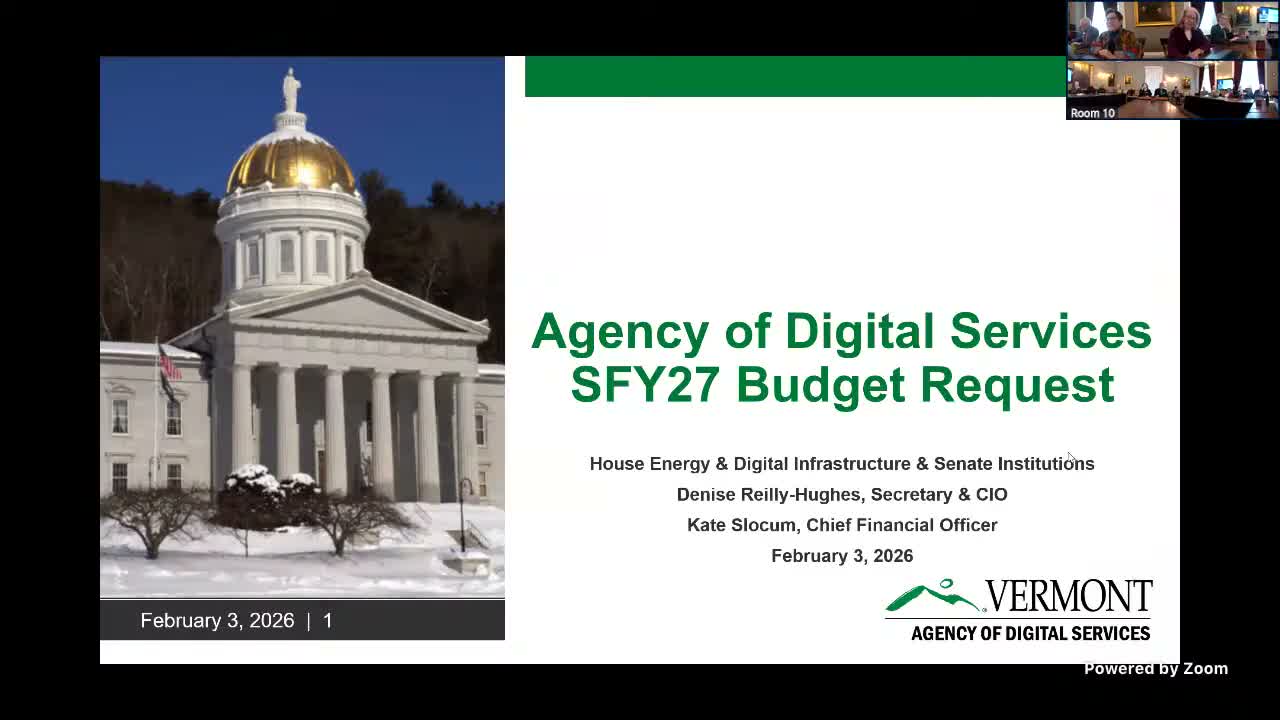
Summary
The Agency of Digital Services asked the joint House and Senate committees for a FY27 total of $96.5 million, proposing a new split between core enterprise services ($49.2M) and demand/project funding. Lawmakers pressed ADS on transparency, the IT modernization fund, vendor payment processes and a one-year transition for budget reporting.
The Agency of Digital Services (ADS) told a joint House–Senate hearing Feb. 3 that the governor’s recommended FY27 budget for ADS totals $96,500,000 and would be presented as two appropriations rather than one. Kate Slocco, chief financial officer for ADS, said the proposal separates foundational “core enterprise services” from demand-driven project spending, with core enterprise services proposed at $49,200,000.
Why it matters: The change is intended to make foundational IT costs — cybersecurity, network access and centralized licensing — visible and predictable at the enterprise level while moving project- and agency-specific costs into demand or agency budgets. Representative Kathleen James, chair of House Energy and Digital Infrastructure, said the committees need clarity so they can draft a timely recommendation to appropriations.
What ADS proposed and why: Randle Hughes, ADS secretary and state chief information officer, described 13 categories of core enterprise services that cover baseline needs across state government, including security, data storage and enterprise licensing. Hughes said the prior arrears-billing model for SLAs made it difficult to project costs and that the split will allow ADS to measure and recover foundational and demand costs differently. “Security is built into foundational services,” Hughes said, describing how enterprise security teams and toolsets are intended to be covered under the core appropriation.
Reporting and transparency concerns: Legislators repeatedly asked how the change will affect the weekly EPMO dashboard and the annual report that committees use for oversight. Hughes said ADS will begin tracking additional dashboard data points — contract ownership and funding owner among them — but that ADS lacks full internal systems access (for example, Workday) and will rely on Finance & Management for cross-agency budget data. James asked ADS for a concise 1–2 page narrative explaining exactly how FY27 presentation differs from prior years.
IT modernization fund and one-time appropriations: ADS staff explained that the IT modernization fund had about $77 million appropriated previously for projects, with roughly $27.4 million remaining as of December and dedicated to specific projects; those amounts are separate from the base ADS budget. Slocco said some project licensing remains on ADS ledgers while invoicing and payment recovery will be directed to the agencies using the services.
Who makes spending decisions: ADS said it will continue to hold contracts and recommend vendor payments, but that the agency or department ultimately decides whether to pay a vendor and receives the invoice. Lawmakers flagged potential procedural confusion from having contract ownership with ADS while payment authority rests with individual agencies and asked ADS and Finance & Management to clarify processes.
Staffing and operational changes: ADS told the committee it has an allocated 389 positions with about a 4% vacancy rate and that roughly 180 staff are counted under demand services. Hughes said the agency has shifted leadership into portfolios while system administrators and developers continue to support the departments they serve; ADS is analyzing duplication and standards across teams to find efficiencies.
Outstanding questions and next steps: Legislators pressed ADS for a crosswalk to show how roughly $42 million of last year’s appropriation will appear in agency budgets this year and for details on how the EPMO dashboard will reflect scattered agency spending. ADS said it cannot produce a complete cross-agency roll-up without assistance from Finance & Management and suggested inviting Commissioner Gresham and fiscal staff from DFM and JFO for follow-up. Representative James requested a short written summary describing the presentation changes for committee use.
The hearing concluded with ADS agreeing to provide written follow-up materials and the committees scheduling additional fiscal review; no formal votes were taken during the session.