
Panel urged to remove 2030 end date from Douglas J. Peters Afghanistan-Iraq scholarship
Get AI-powered insights, summaries, and transcripts
Subscribe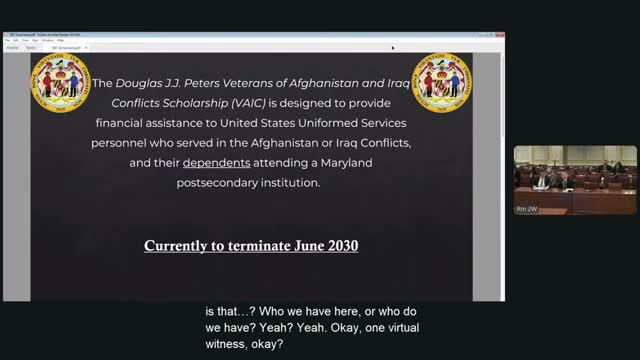
Summary
Sen. Simon Ayre and veterans’ advocates told the Education, Energy and the Environment Committee SB 7 would remove the program’s June 30, 2030 termination, giving service members and dependents long-term certainty; witnesses said about 100 people use the scholarship yearly and urged a favorable report.
Senator Simon Ayre introduced Senate Bill 7, asking the committee to remove the statute’s June 30, 2030 termination for the Douglas J. Peters Afghanistan and Iraq conflict scholarship so the award would continue indefinitely.
The bill, Ayre said, "simply removes the termination date of June 2030" and aligns the scholarship with other Maryland law so military families can plan for future education without an arbitrary expiration. He told senators the scholarship was created in 2006 and has been extended several times, most recently to 2030.
An in-person witness, Giuseppe Mellinger, described personal stakes. Mellinger said he and his sister are currently eligible and warned that a fixed 2030 cutoff could leave future children of service members ineligible. "If he were to have a kid now, that kid would not be eligible for this scholarship even though he earned it, through service," Mellinger said.
Dave Dragic, legislative director for the Maryland Military Coalition, testified virtually in support and cited documentation rules (DD‑214 and federal definitions of contiguous waters/airspace) that define eligibility; he said there are current Maryland service members who would return to civilian life and need the benefit beyond 2030.
Committee members asked about program uptake and promotion. Ayre said approximately 100 people use the scholarship each year and acknowledged questions about how the Maryland Higher Education Commission promotes the award.
With support from veterans’ groups, higher-education stakeholders and the Department of Veterans and Military Families cited by the sponsor, proponents asked the committee to report the bill favorably so families receive consistent access to the benefit.
The committee concluded the SB 7 hearing without a recorded vote; the bill’s next steps were not stated during the hearing.