
Edgefield County gives first reading to stricter tree-preservation ordinance with mass-grading limits
Get AI-powered insights, summaries, and transcripts
Subscribe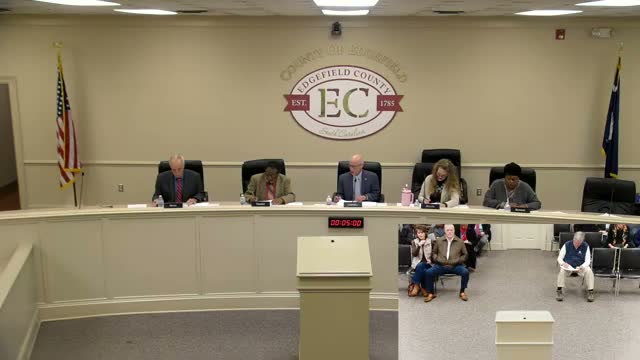
Summary
Edgefield County Council gave first reading to a proposed tree preservation ordinance that would require a 30% canopy density for major subdivisions, establish buffers, require professional tree surveys and add mass-grading limits; the measure advances after public comment and staff clarification and will return for further review by the Planning Commission before second reading.
Edgefield County Council on [date not specified] gave first reading to a proposed tree preservation ordinance that would tighten requirements for new subdivisions and commercial development, add mass-grading restrictions and require qualified professionals for tree-health determinations.
The ordinance, presented by County Administrator David, would require major subdivisions to leave or restore a 30% canopy density, place a 50-foot vegetative buffer along primary frontage roads (with a mix of trees and shrubs), and require a tree survey prepared by a competent professional. For commercial sites the measure calls for a 20% canopy retention within a type-2 buffer and establishes landscape islands or infill plantings in parking areas to meet the requirement. David described the measure as “one of the most strict tree preservation ordinances of a county in the state” while noting municipalities can be more stringent.
Why it matters: supporters say the ordinance is designed to preserve the county’s rural character and reduce soil loss and runoff associated with large-scale grading. Opponents and public commenters urged clarity on who may perform surveys and on hydrology and soil suitability requirements before sites are stripped for development.
During public comment, Crystal Branton of Bremer Oak urged the council to limit who may perform tree surveys to credentialed arborists and registered foresters, arguing that architects, engineers and surveyors “do not hold the specialized biological or forestry credentials required to properly evaluate tree species, health or environmental significance.” The county administrator acknowledged that concern and said the ordinance was revised so that health determinations and removals for substandard trees would require a forester, arborist or landscape architect rather than an engineer or surveyor.
The ordinance also includes provisions addressing mass grading. The administrator explained staff’s approach: mass grading should be limited on large residential developments (the draft caps concurrent mass-graded lots at five in a single lift rather than larger counts used elsewhere), requires topsoil stripping and preservation during construction, sets slope limits for cut-and-fill operations, and calls for limits on grading of detention and retention pond slopes to protect staff safety. “We will require topsoil preservation,” David said, citing past instances where grading practices caused downstream complaints.
Council discussion touched on technical details and definitions. Councilmember Moody asked whether a 60‑month waiting period after timber harvest should be extended to 72 months; David responded that the ordinance’s 30% canopy-restoration requirement makes premature redevelopment cost-prohibitive in many clear-cut cases. Members also asked that common forestry standards (such as diameter-at-breast-height measurement) be included in definitions.
What happened next: Councilmember Talbert moved and Councilmember Ireland seconded first reading of Ordinance 25‑26‑0007; the motion passed unanimously. David said the Planning Commission will consider staff-proposed language on mass-grading at its next meeting and that the ordinance would return to council for further reading and potential amendments.
The ordinance’s next procedural step is review by the Planning Commission and a second reading before the full council. If approved on subsequent readings the measure would change county development review and enforcement practices by codifying canopy, buffer and grading standards that county staff said are intended to preserve local environmental and scenic character.