Get Full Government Meeting Transcripts, Videos, & Alerts Forever!
Get email alerts on the Water Supply Agreement topic
No spam. Unsubscribe anytime.
SFPUC, BOSCA outline regional water outlook and contract timeline as demand falls
Summary
SFPUC staff and the Bay Area Water Supply and Conservation Agency presented regional demand scenarios showing lower-than-expected wholesale purchases and highlighted a 184 million gallons-per-day supply assurance in the 2009 water supply agreement, which expires in 2034 with amendment opportunities.
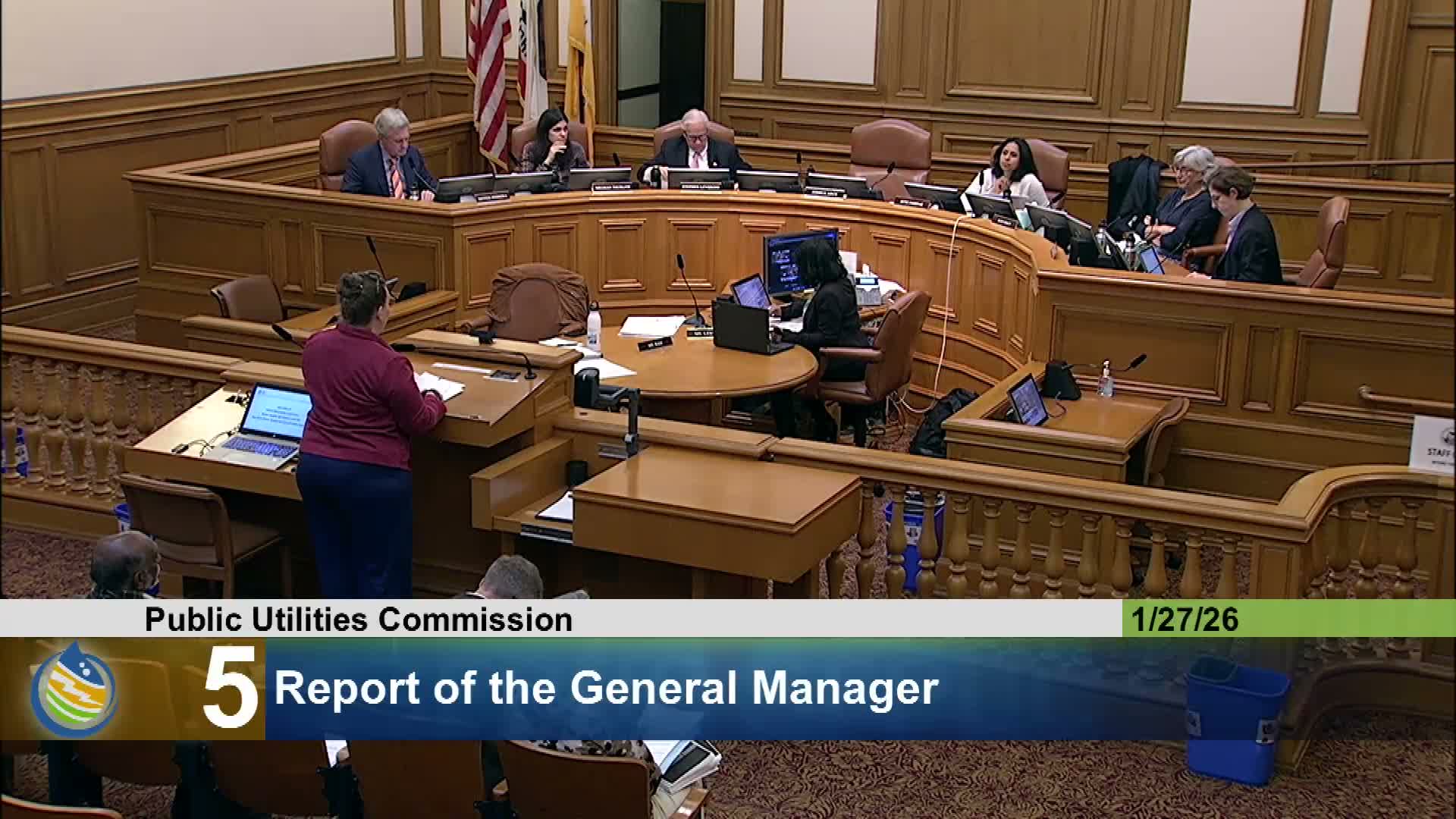
The San Francisco Public Utilities Commission heard a detailed briefing on the regional water supply agreement and demand forecasts on public comment and staff presentations at its meeting.
Allison Kostima, presenting the San Francisco PUC overview of wholesale customers, said the Hetch Hetchy regional system serves more than 2.7 million residents across four Bay Area counties and that the current water supply agreement — a successor contract from 2009 — includes a supply assurance of 184,000,000 gallons per day to the wholesale service area. The contract, Kostima said, expires in 2034 and includes two five-year extension options.
Kostima outlined other contract mechanics that are central to planning: individual supply guarantees (ISGs) allocated among wholesale customers, the water-shortage allocation plan (Attachment H) that dictates drought allocations, and section 3.06 obligations which require wholesale customers to comply with state and federal conservation and recycled-water expectations. "The contract does include what's called the supply assurance," Kostima said, describing the 184 million gallon-per-day figure and how ISGs are used in urban water management planning.
BOSCA CEO Tom Smigel and other BOSCA representatives presented regional demand work that accompanies the PUC's analysis. BOSCA's five‑year demand study projects wholesale demand in 2050 of roughly 222 million gallons per day across 26 member agencies, with an SFPUC purchase estimate of about 148 MGD under the baseline scenario. BOSCA's scenario envelope ranges from about 157 MGD on the low end to 266 MGD on the high end depending on growth and conservation assumptions.
Smigel and commissioners stressed that historic demand declines and conservation measures have reduced per-capita usage and that these changes complicate planning; several commissioners pressed staff on whether ISGs create disincentives for wholesale customers to develop alternative supplies. "Some of those gaps are a result of significant water conservation and alternative water supply usage," Smigel said, urging caution in assuming that spare ISG capacity in a normal year would be reliably available in drought conditions.
Commissioners asked about the timeline for contract changes. Staff said earlier amendments have eased the mechanics of transferring portions of ISGs among wholesale customers, and that while negotiation can occur before 2034, complex multilateral amendments historically take several years. The commission and stakeholders noted a 2028 decision point embedded in existing contract dates for some Santa Clara–area provisions.
Public commenters, including conservation and river-alliance advocates, urged the commission to use updated drought definitions and sensitivity analyses in planning. Several callers asked staff to run financial scenarios for lower-demand futures and to include the potential budgetary impacts of sharply reduced wholesale purchases.
What happens next: SFPUC staff said it will keep working with BOSCA, wholesale customers and stakeholders on demand scenarios, urban water management plan inputs and any contract amendment packages; the commission encouraged continued public engagement ahead of formal amendment or extension decisions.