Get Full Government Meeting Transcripts, Videos, & Alerts Forever!
Get email alerts on the Water topic
No spam. Unsubscribe anytime.
West Haven council adopts water use and preservation element for general plan
Summary
The West Haven City Council approved a new advisory water use and preservation chapter required by state law after a Landmark Design presentation outlining metering, conservation goals and implementation strategies, and steps to coordinate with local water providers.
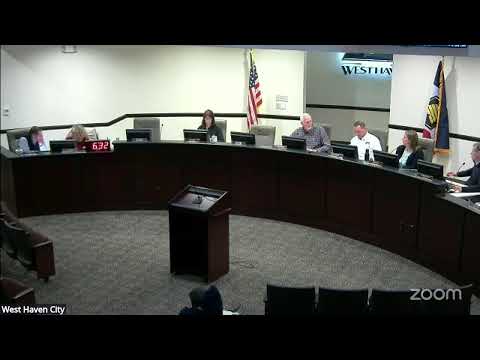
West Haven Mayor Rob Vanderwood and the City Council on Dec. 3 approved Resolution 54-2025, adopting a water use and preservation element as a new chapter of the city’s general plan.
The element, prepared by Landmark Design and presented by consultant Aubrey Larson, responds to state requirements in Senate Bill 110 and Senate Bill 76 that cities adopt a water-focused component in their planning documents. Larson said the chapter is advisory and does not create new regulations but provides goals and implementation strategies to guide land-use decisions and water stewardship.
“This essentially functions as a new chapter of your general plan,” Larson said, adding that the document is meant to “describe where you are, where you want to be, and how you will get there.” Steven Nelson, West Haven’s community development director, told the council the plan codifies outreach and consultation the city completed with its four local water systems and the Weber Basin Water Conservancy District.
Key elements in the adopted chapter include clarifying administrative responsibilities between the city and water providers, advancing shared regional conservation goals, and updating local policies and landscape standards. The consultant highlighted a new state requirement that pressurized secondary-water connections be metered by Jan. 1, 2030, and recommended improved local data collection to close current gaps in usage information.
Larson presented outreach findings showing roughly half of survey respondents felt the city was not doing enough on water; she also noted strong resident interest in water-wise landscaping programs and existing participation in the Utah Water Savers smart-controller rebate (270 participants since 2018). The draft uses the state standard of 0.45 acre-feet per dwelling unit (culinary water only) for trajectory modeling, and the chapter lists potential implementation actions such as refining development-review requirements for water impacts, strengthening landscape standards, and coordinating incentive programs.
During discussion, councilmembers asked about when water-use studies should be done, whether developers could be required to provide water analyses at application, and how agricultural-to-residential conversions affect demand. Nelson and Larson said some developer review requirements already exist for commercial and multifamily projects, that water districts often provide impact-fee analysis tied to units, and that agricultural water use varies by crop (alfalfa typically uses more water than grazing). Larson also emphasized the plan’s emphasis on outdoor irrigation efficiency, since landscape irrigation accounts for a majority of residential water use.
After debate, the council moved and approved Resolution 54-2025 by roll call vote (three ayes). The adopted element now serves as the city’s advisory guide for future land-use decisions and water-conservation work; many of the chapter's strategies (data-sharing with water providers, metering secondary systems, and landscape-standards refinements) will require follow-up implementation steps and coordination with regional water agencies.
The council directed staff to proceed with the next steps identified in the plan, including further outreach to residents and coordination with the Weber Basin Water Conservancy District, and to return with ordinance or administrative changes as needed for implementing the chapter’s recommendations.