
Clark County proposes broad stormwater manual changes, including ban on deep injection wells
Get AI-powered insights, summaries, and transcripts
Subscribe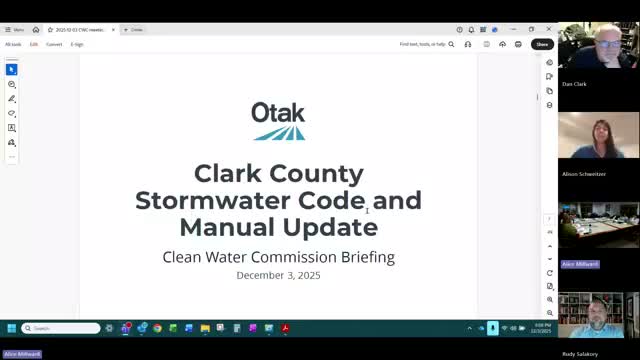
Summary
Clark County staff and consultants presented proposed updates to the Clark County Stormwater Manual and Title 40 code to meet Department of Ecology Phase I permit requirements, including seven mandated permit items, a proposed prohibition on deep underground injection control wells, deeper soils testing for infiltration, and a public review schedule leading to adoption in June 2026.
Clark County officials on Dec. 3, 2025, presented a package of proposed updates to the county's Stormwater Manual and related Title 40 code designed to comply with Department of Ecology Phase I municipal stormwater permit requirements and to improve local stormwater practices.
Consultant Trista Koblowski of OTEC told the Clean Water Commission the update combines three streams of work: seven Ecology‑mandated items (summarized in Appendix 10 of the permit), community‑requested changes, and selected technical updates from the Western Washington Stormwater Manual. "We are responding to that requirement in the latest Phase I permit to update the stormwater and drainage," Koblowski said, noting Ecology will issue formal comments in mid‑December and staff expect a public review period to begin later that month.
Why it matters: county staff said the update is intended to preserve water‑quality protections while clarifying design and maintenance requirements for developers, inspectors and homeowners ahead of an adoption timeline that targets county council action in May–June 2026 and an effective date of July 1, 2026.
Key items outlined by staff include seven permit‑mandated changes—thresholds for redevelopment projects, clarified project exemptions, refined definitions tied to minimum requirements, additional guidance for protecting wetlands receiving facility outflows, adjusted runoff‑treatment performance thresholds (including changes affecting metals treatment and specifying new land uses that require treatment), new source‑control best management practices with added language addressing PCBs, and a new high‑performance bioretention soil mix that can be used near phosphorus‑sensitive water bodies. Koblowski said the new soil mix "does not export phosphorus and there is a version of it that can actually be used as phosphorus treatment."
Local policy changes and technical clarifications: presenters described several local proposals beyond the Ecology mandates. County staff are proposing to prohibit deep underground injection control (UIC) wells — drilled shafts that can extend tens of feet below standard dry wells — "to protect the safety of the aquifer," Koblowski said, citing Clark County's reliance on a sole‑source aquifer. The county also plans to require more extensive pre‑design soil and groundwater investigations: staff propose increasing typical soil‑log depth for downspout infiltration from about 4 feet to 10 feet so designers do not rule out infiltration prematurely.
On siting and design, staff said they will tighten guidance for outfalls and energy dissipators and reduce risky siting at the tops of steep slopes. They also plan to narrow which engineered stormwater facilities are appropriate on private residential lots to avoid creating maintenance obligations that homeowners cannot meet.
Treatment and pretreatment: the county intends to require "basic treatment" (sediment removal) before using UICs and to support higher‑level phosphorus sorbents where appropriate. Koblowski described the pretreatment requirement as protective of long‑term facility function, noting some underground infiltration devices have clogged or failed in other jurisdictions.
Groundwater mounding and safety: commissioners heard staff propose a revised threshold for when a groundwater mounding analysis is required for larger infiltration facilities; staff said the county will require the analysis if available information indicates groundwater is within 5 feet of the bottom of a proposed facility to reduce risks of backup or chronic flooding.
Training, outreach and budget: county staff emphasized training for internal reviewers, inspectors and external designers and said the commission had an allocation in place to support training development. Koblowski said county staff will request a budget amendment from the council to cover expanded outreach and coordination tied to the project.
Process and timeline: staff described a special public review period in December for the Clean Water Commission and other advisory groups, a council work session tentatively scheduled for Jan. 14, 2026, planning commission briefings in April–May, council hearings in May–June and adoption in June with an effective date of July 1, 2026. Koblowski said Ecology's formal feedback on the June submission is expected at the Dec. 16 meeting.
Votes and procedure: at the meeting outset commissioners moved to approve the Oct. 2025 meeting summary; the motion was seconded and commissioners signaled unanimous or broad vocal approval by saying "aye." The presentation continued after a brief technical interruption.
Speakers and participants quoted in this report appear as recorded in the commission transcript: Trista Koblowski (consultant, OTEC), Rod Swanson (stormwater policy lead), Bob Hatrock (new member; former City of Portland Bureau of Environmental Services), Dan Clark (commissioner‑elect, Clark Regional Wastewater District) and other commissioners and staff.