Committee advances bill to narrow definitions for civil commitment, amid mixed testimony
Loading...
Summary
Sen. Maestas' Senate Bill 3, revising definitions used in civil commitment and assisted outpatient treatment statutes to focus on recent dangerous behavior and decisional incapacity, passed committee after friendly amendments and public testimony from advocates and first responders.
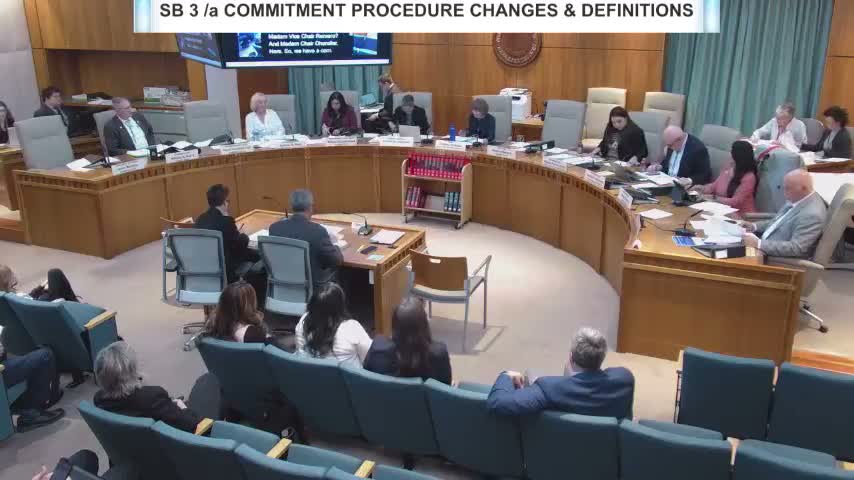
Sen. Maestas, the bill sponsor, told the House committee that Senate Bill 3 revises two definition sections—the mental health code (43-1-3) and the assisted outpatient treatment act (43-1B-2)—to make court determinations more concrete by focusing on recent past behavior and decisional capacity. "Likelihood of serious harm to oneself means... it's more likely than not," the sponsor said, and described language changes that emphasize recent acts or attempts to inflict serious bodily harm.
The committee adopted an advocate-drafted amendment (committee substitute 233733.2) that, according to the sponsor, clarifies terms, removes an ambiguous ‘‘grave passive neglect’’ phrase, adds the adverb "intentionally" in a provision about self-inflicted death, and inserts the phrase "as determined by a qualified mental health professional" in a decisional-capacity sentence. Leader Sapanski moved to adopt the amendment; the motion met no opposition and the bill was returned to the sponsor as amended.
Several disability advocates urged caution. Ellen Pines, representing the Disability Coalition, thanked the sponsor for adopting the amendment but said the group still had concerns about involuntary mental-health treatment and the state's limited behavioral-health services. "We would urge you to let that process play out and bear fruit before making these changes to the commitment statutes," Pines said. Daniel Williams, a policy advocate at the American Civil Liberties Union of New Mexico, told the committee that "civil commitment is a serious deprivation of people's liberty and should only be used in extreme circumstances."
Supporters — including JD Bullington of the Greater Albuquerque Chamber of Commerce, law-enforcement and fire personnel — said clearer legal standards help providers, judges and first responders. "Clear standards matter for providers, courts, families, and communities responding to behavioral-health crises," Bullington told the panel. Jeremy Stewart, identifying himself with LCPD, said the definitions could allow officers an alternative to repeatedly taking the same individual to jail, and Major Lorenzo Jure of the state police said the bill would "remove uncertainty for officers in the field." Firefighter Miguel Tibbman said clarified definitions could reduce repeated hospital transports and free emergency resources.
Representative Reeb proposed, and the sponsor accepted as friendly, inserting the word "serious" in several definition cross-references to maintain consistency across chapter 43-1-1. Representative Romero flagged a separate drafting concern: archaic statutory language referring to "lobotomy" on page 7, line 10. Romero said she was "shocked to kinda see lobotomy in there" and asked whether the language should be updated; committee members said they would note the concern.
On the motion to pass the bill as amended, the clerk called the roll. The committee recorded 10 yes votes and issued a "do pass" recommendation to the Senate. The sponsor said he would ask his body to concur when the bill returns to the Senate.