
Vermont special‑education leaders warn Act 73 weighting could jeopardize federal IDEA funding
Get AI-powered insights, summaries, and transcripts
Subscribe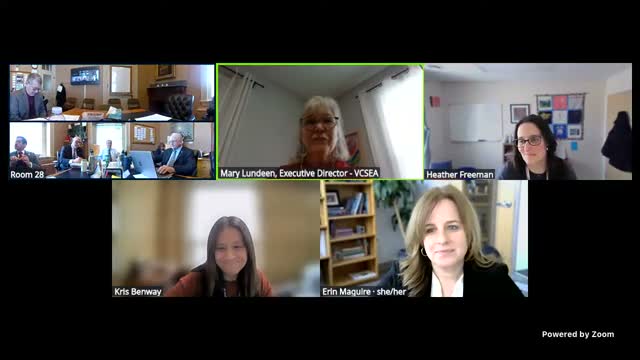
Summary
Leaders from the Vermont Council of Special Education Administrators told the Senate Education Committee that the Act 73 weighting model could underfund districts, risk maintenance‑of‑effort compliance under IDEA, and urged a per‑student special‑education weight and careful glide path for implementation.
Mary Lundeen, executive director of the Vermont Council of Special Education Administrators, told the Senate Education Committee on Feb. 3 that VCSEA’s focus is fiscal integrity to protect IDEA and students with disabilities as the state implements Act 73’s foundation formula.
"Our primary goal is to engage in a meaningful dialogue," Lundeen said, framing two central concerns for the committee: the special‑education weighting design within the new foundation formula and the development of cooperative education service agencies (CESAs).
Heather Freeman, director of student support services in the Orleans Southwest Supervisory Union and VCSEA president‑elect, explained the federal maintenance‑of‑effort requirement under IDEA Part B. "It is our responsibility as LEAs to both budget for and spend the same amount of state and/or local funds from year to year," Freeman said, adding that failure to meet MOE can force districts to treat shortfalls as unallowable federal‑fund uses and may require repayment from nonfederal sources.
Chris Benoit, president of VCSEA and special‑education director for Slate Valley Unified School District, argued that linking special‑education funding to broad disability categories risks incentivizing diagnosis over individualized need. "The weighting formula does not provide sufficient dedicated support for special education," Benoit said. He urged the legislature to consider a single special‑education weight per student, rather than weights tied to disability categories, with a multi‑year glide path to implementation.
Erin McGuire, special‑education director for Essex Westford School District, presented a district impact estimate: modeling the Act 73 weights for Essex Westford would leave the district about $6,000,000 short in special‑education funding — a shortfall she said would likely need to be backfilled from foundation‑formula dollars to meet MOE. "When I modeled out the Act 73 design for Essex Westford, I was short $6,000,000 in special education," McGuire said, adding that this shortfall represented a rough estimate of about 9% of the district’s non‑special‑education budget in her informal calculation.
Panelists told senators they have sought to engage the Agency of Education and stand ready to partner on impact analyses, technical assistance, and alternatives. VCSEA emphasized that CESAs could help address regional staffing shortages and access to specialized services but must not supplant district responsibility for special‑education decision‑making or decrease inclusion; they also urged that people with disabilities have a voice in CESA design.
Senators asked whether districts could meet MOE exceptions and how federal funds interact with the foundation formula. Panelists reiterated that IDEA funding is contingent on meeting MOE and that allowable exemptions (for example, a highly expensive student leaving the district) are documented in the MOE guidance materials the witnesses submitted.
The committee did not take action; members thanked the witnesses and asked VCSEA to continue discussions with the Agency of Education and return with impact analysis and potential technical solutions.