
Kings County supervisors direct staff to model options for using $6.77 million in JPA reserves for courthouse remodel
Get AI-powered insights, summaries, and transcripts
Subscribe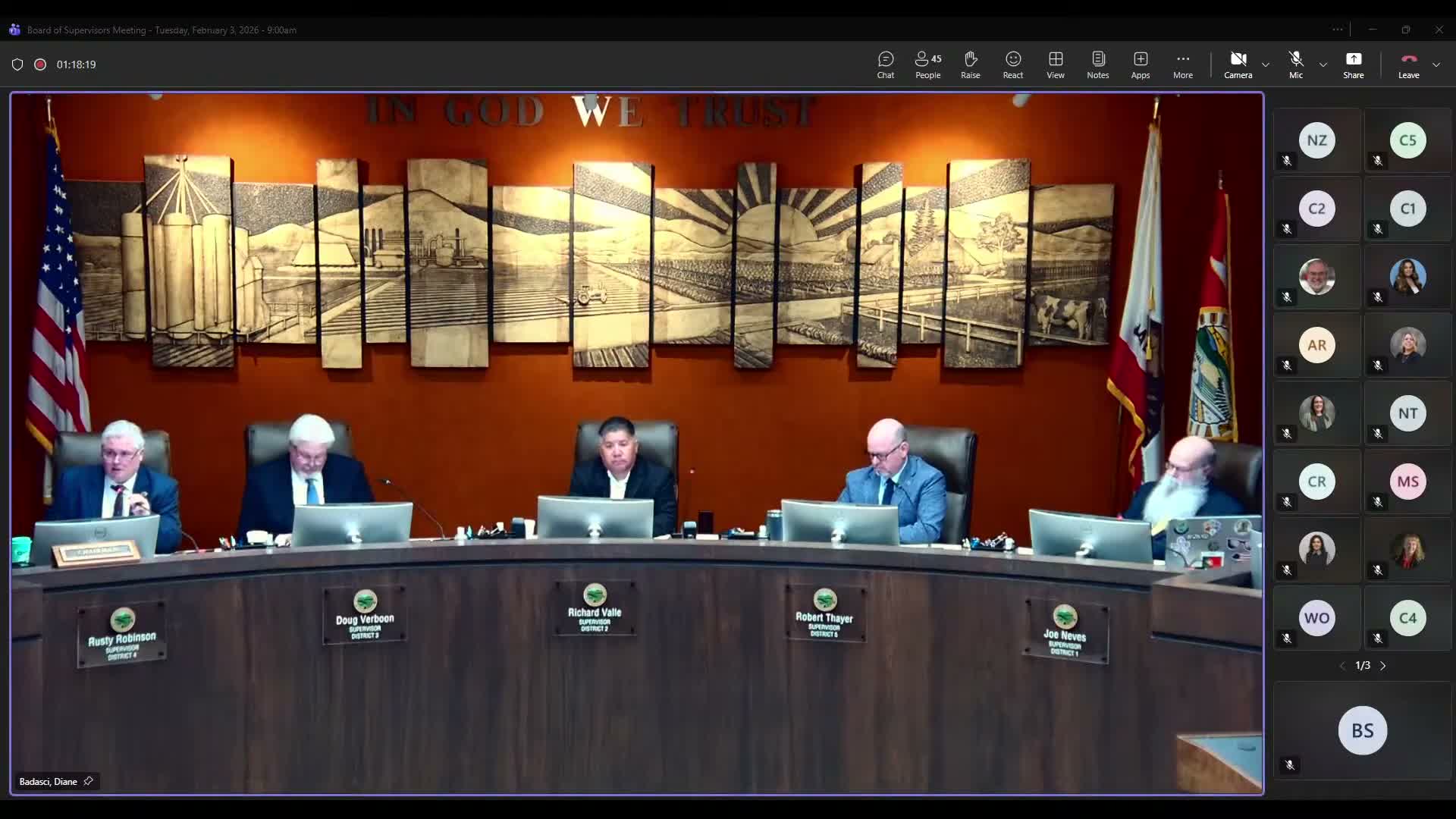
Summary
County staff reported CalPFA and CalCHA balances totaling $6,765,941 and the board directed staff to return with scenarios showing potential savings from using some or all of those JPA funds to reduce borrowing for a roughly $40 million courthouse remodel.
Kings County supervisors spent a study session weighing whether to tap joint-powers authority reserves to reduce borrowing for a planned $40 million courthouse remodel.
Assistant CEO Matthew Boyette told the board the two JPAs in which the county participates — the California Public Finance Authority (CalPFA) and the California Community Housing Agency (CalCHA) — hold fee balances that, as of Dec. 31, 2025, total $2,259,016 for CalPFA and $4,506,925 for CalCHA, a combined $6,765,941. Boyette said those funds are held by the separate JPAs and are not obligations of the county; any county use would require formal approval from the JPAs.
“Those balances have been accumulating year over year,” Boyette said, noting one option would be to request a transfer or other use from the JPAs to buy down debt for the courthouse project. He told supervisors that, depending on loan terms and interest rates, applying JPA funds to principal could yield interest savings roughly equivalent to the sums applied over the life of financing.
Board members voiced competing priorities. Several supervisors said paying down debt could reduce overall interest costs and produce a large return on investment, while others stressed the funds were created to support community projects and local infrastructure and urged preserving a portion of the reserves for district-level needs. One supervisor asked staff to prepare options allocating portions of the funds (for example 20%, 30%, 40% to local projects) while reserving the remainder for the courthouse; others asked for an estimate of interest savings if the county paid down the full $6.77 million.
CEO Martinez and Boyette clarified that staff would need the JPAs’ formal consent and that, even if the county sought to use the funds, the JPAs are separate legal entities whose approval would be required before any transfer or borrowing arrangement could proceed.
The board did not take a formal vote to spend the JPA balances. Instead, supervisors gave staff direction to return in the coming weeks with: scenario analyses showing (a) estimated interest savings if funds were applied to debt, (b) options to divide a portion of the funds among district projects, and (c) possible structures such as enterprise or rolling capital accounts for future building replacement needs. Staff will also estimate realistic financing terms and multiple “what-if” scenarios for the board’s consideration.
Next steps: staff will prepare the scenarios and financial illustrations requested and bring recommendations back to the board for formal action.