Connecticut Senate extends Federal Cuts Response Fund, rejects three oversight amendments
Loading...
Summary
After several hours of floor debate on checks and balances and spending authority, the Connecticut Senate passed emergency‑certified Senate Bill 83 to extend the Federal Cuts Response Fund through fiscal year 2027. Three amendments — to refund excess funds, require legislative approval for expenditures, and add application and reporting safeguards — failed on roll calls.
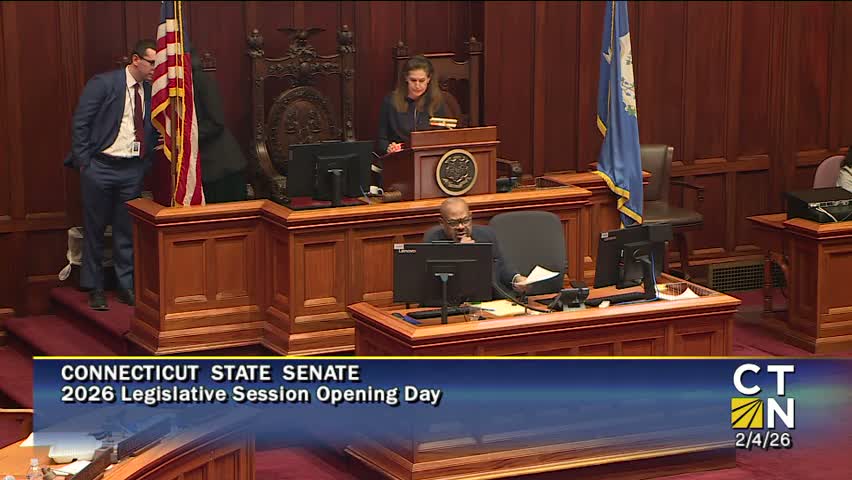
Hartford — The Connecticut State Senate on Wednesday passed Senate Bill 83, an emergency‑certified measure extending the Federal Cuts Response Fund, by a roll‑call vote of 28–8.
The bill continues a state reserve intended to let Connecticut respond quickly if federal programs or grants are reduced or altered. Senator Cathy Austin moved acceptance of the emergency bill on the floor, saying it “extends the federal cuts response fund until the end of fiscal year 27, continuing the response to any federal cuts.”
Opponents argued the extension cedes too much authority to the executive branch while the legislature is in session. “We are giving 1 man the ability to spend hundreds of millions of dollars in a virtually unchecked manner,” Senator Fazio said on the floor, framing the issue as a constitutional separation‑of‑powers concern and contending the legislature should exercise taxing and spending authority directly.
Senator John Sampson offered an amendment (LCO 675) to return the unspent balance — which Senators cited in debate as roughly $330 million — to taxpayers in the form of refunds. Sampson framed the proposal as an affordability measure: “I believe that money should be returned back to those taxpayers,” he said, noting prior political debate over how much of the original $500 million had already been spent. The Senate rejected that amendment on a roll‑call vote.
Senator Jorge Gordon offered a separate amendment (LCO 677) that would have required a majority approval of both houses before any disbursement from the fund. Gordon said legislative approval was necessary to preserve representative oversight and prevent the fund from becoming a “slush fund.” That amendment was also defeated in a roll‑call vote.
A third amendment (LCO 678), offered by Senator Ciccarella, would have imposed an application process and reporting requirements for any recipients of fund money, modeled on existing competitive grant processes. Proponents said it would guard against waste, fraud, and duplication; it failed on a roll call as well.
Supporters of SB 83 argued that the fund has already been used to address immediate needs arising from volatile federal decisions, and that maintaining the independent mechanism preserves Connecticut’s ability to protect vulnerable residents. “This is an opportunity for us to be able to control a little bit and be able to protect some of the emergency gaps that happen here coming into Connecticut,” Senate Majority Leader Bob Duff said in defending the extension. Senate President Pro Tempore Martin Looney added that recent federal actions have been capricious and that the state needs on‑hand resources to respond quickly.
The record cited earlier allocations from the original $500 million fund, with senators noting roughly $169,188,046 spent to date and the remainder (reported in debate as $330,811,954) left to be allocated if the extension were approved.
After final remarks, the Senate ordered an immediate roll‑call vote. The clerk reported 36 senators voting, with 28 in favor and 8 opposed; the bill passed and Senator Duff moved to transmit it to the House of Representatives for action.
The session adjourned after the vote. The House is expected to consider the emergency bill following its transmission.
What remained unsettled after the vote was not the fund’s existence but the scope of oversight. Opponents repeatedly urged greater legislative approval, reporting and audit mechanisms, and public hearings before future disbursements. Proponents emphasized speed and flexibility to counter sudden federal changes. The Senate’s vote preserves executive flexibility while leaving intact proponents’ and opponents’ divergent views on how to balance responsiveness with accountability.