Get Full Government Meeting Transcripts, Videos, & Alerts Forever!
Get email alerts on the Rates And Finance topic
No spam. Unsubscribe anytime.
Wausau reviews rate comparisons, pilot payments and solar RFP timing ahead of potential rate actions
Summary
Commissioners heard that Wausau's water rates are midrange locally and top-third among large utilities statewide; staff recommended small, frequent rate increases to smooth costs, explained the PSC process, and flagged a solar array RFP timing risk that could affect tax-credit eligibility.
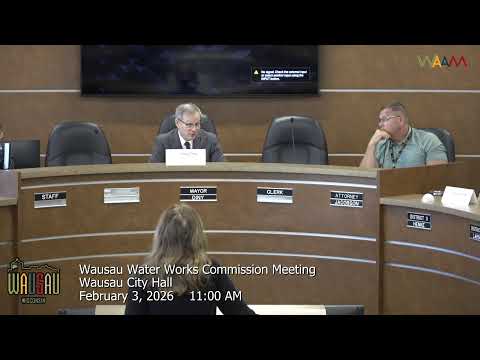
Commissioners reviewed a series of finance items including a PSC-based rate comparison, the payment in lieu of taxes (pilot) arrangement, and the solar array engineering RFP.
Scott said he ran PSC rate comparisons and found Wausau roughly midrange among Marathon County utilities and in the top third among utilities serving 4,000+ customers statewide; the city is not the highest-rate system in Wisconsin. Responding to concerns about rising treatment costs (chemicals, granular activated carbon, PFAS treatment), staff and Commissioner Aaron Greiner discussed sustainability and timing for future rate filings. Finance director Grot explained that the PSC permits a short-form annual interim increase (a small automatic adjustment) and that full rate cases, typically handled with consultants like Ehlers, are more involved and can take multiple months with PSC follow-up questions.
On the pilot payment (payment in lieu of taxes), staff said the utility's pilot calculation is generated by PSC formula and that the council must adopt any resolution to accept a lower payment. Staff cited a current utility pilot figure of about $1,590,000 annually and said the city is effectively forgiving roughly $400,000–$500,000 of that total across water and sewer according to council decisions; the commission has input but the council sets the pilot by resolution.
Separately, staff said the RFP for solar array engineering is advertised, proposals are due in February, and a contract could be signed by mid-March with earliest construction start around August–September; an EPA grant decision is expected in May–June. Scott cautioned that the RFP schedule likely adds 3–4 months to the project and could affect eligibility or amount of federal tax credits tied to construction start dates (the staff timeline affects whether certain credits linked to beginning construction before July 4, 2026, are available).
Commissioners asked for a 10- to 15-year rolling history of rate changes to inform decisions about whether to pursue small annual increases. Staff said they will prepare historical rate-change data, continue cash-flow and PSC analyses, and work with Ehlers to determine if an interim or full rate case is advisable. The commission will continue to monitor the PFAS settlement funds and other offsets that could mitigate future rate increases.