Get Full Government Meeting Transcripts, Videos, & Alerts Forever!
Get email alerts on the Climate And Multilateralism topic
No spam. Unsubscribe anytime.
Kiribati urges stronger multilateralism, climate action and IUU enforcement in UN address
Summary
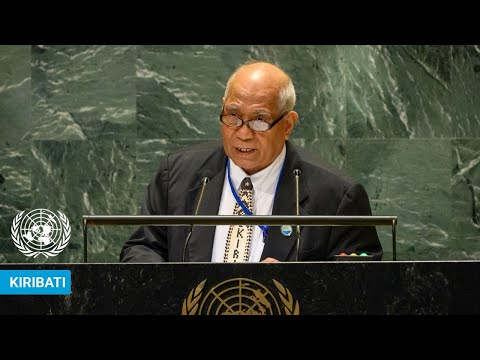
Tiborohu Tito, head of Kiribati's delegation, marked 25 years of UN membership and urged the General Assembly to strengthen multilateralism, reform the Security Council, uphold the 1.5°C target, bolster adaptation for low-lying atolls and crack down on illegal, unreported and unregulated fishing.
Tiborohu Tito, head of the delegation of the Republic of Kiribati, used his address to the United Nations General Assembly to mark his country’s 25th year of membership and press for stronger global cooperation on climate change, Security Council reform and maritime enforcement.
“Kiribati joined this esteemed body and became the 186th member,” Tito said, noting the country’s membership began on 14 September 1999. He framed the Assembly’s theme — leaving no one behind — as “timely” amid escalating conflicts and displacement and urged member states to recommit to the UN’s core principles of peace, justice and human dignity.
Tito called for reinvigorated multilateralism and greater respect for the UN Charter and national sovereignty. He said lack of unity and the proliferation of exclusive groupings have undermined the organization’s ability to prevent and resolve conflicts and argued that Security Council reform is necessary “to make the United Nations fit to deal effectively with new and complex challenges.”
On climate, Tito emphasized the existential threat facing low-lying atolls, urging that international pledges translate into concrete adaptation measures. “We strongly advocate for global climate action, including maintaining the 1.5 degree Celsius goal and addressing sea level rise as essential to safeguarding the livelihoods, identity, sovereignty, and security of the Pacific Island communities,” he said, adding that adaptive infrastructure such as resilient seawalls remains a priority.
Tito highlighted Kiribati’s economic vulnerability and reliance on ocean resources: “Our tuna fishing license revenue … finances about 70% of the government’s annual expenditure budget,” he said, and noted the country’s extensive exclusive economic zone of roughly 3,500,000 square kilometers. He warned that illegal, unreported and unregulated (IUU) fishing depletes stocks, undermines sustainable practices and reduces revenue for local fisheries, calling on the international community to strengthen cooperation to combat IUU fishing.
He also reaffirmed Kiribati’s support for global nuclear disarmament, citing the nation’s historical experience of nuclear testing and expressing solidarity with states advocating for the prohibition of nuclear weapons. Tito said Kiribati has contributed police personnel to the United Nations peacekeeping mission in South Sudan and pledged continued participation in collective security efforts.
In closing, Tito welcomed the Secretary‑General’s initiatives to renew the United Nations ahead of its 80th anniversary, expressed support for the proposed Pact for the Future and the global digital compact, and urged member states to take “bold steps to strengthen global governance mechanisms” so that vulnerable nations are not left behind.
The address did not contain any formal motions or votes. The delegation’s remarks set out priorities Kiribati expects the Assembly and partners to address in coming discussions.