Get Full Government Meeting Transcripts, Videos, & Alerts Forever!
Get email alerts on the International Relations topic
No spam. Unsubscribe anytime.
Morocco envoy rejects Algeria—s claims, says Algeria is blocking Sahara talks
Summary
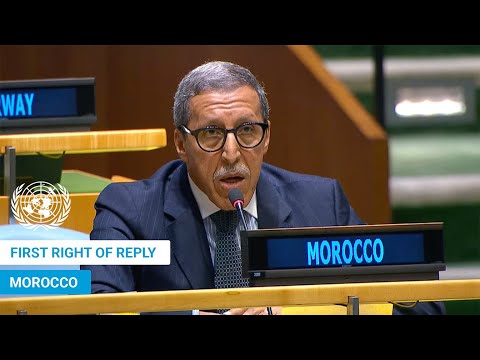
At the U.N. General Assembly, the Representative of Morocco used a right of reply to reject Algeria—s remarks on the Sahara, saying Morocco has integrated the territory for 50 years, accusing Algeria of refusing to negotiate, and blaming Algeria for regional security problems.
The Representative of Morocco used a right of reply at the United Nations General Assembly to rebut remarks by Algeria's foreign minister and defend Rabat's position on the Sahara. He said Morocco has integrated the territory "in terms of its integration in the motherland" for "50 years" and disputed Algeria's characterization that the Sahara needed decolonization.
The representative framed his remarks as responses to three "mistruths" he attributed to the Algerian minister. He cited what he called historical instruments, saying a resolution "3 4 5 b" and the "Madrid agreement" marked the end of Spanish rule and the return of the Sahara to Morocco's authority. He added that international recognition and diplomatic steps supported Morocco—s position: "over a 100 members of the international community supports the Moroccan autonomy initiative," and, he said, several European states had recently recognized that initiative.
On the U.N. political process, the representative challenged Algeria's claim of supporting the Secretary-General's envoy. He said the personal envoy was appointed "three years ago" but had not been able to convene meetings because, he alleged, "Algeria is refusing to return to the negotiating table" and was imposing conditions on who could participate.
The envoy pointed to on-the-ground developments as evidence of Moroccan administration, listing infrastructure and investment: motorways, what he described as "the longest bridge in Africa," hospitals, universities, schools, foreign investment and solar projects, and "4,000 trucks crossing at the Gilgaleta Passage." He also said "29 consulates have been opened in Moroccan Sahara, and the thirtieth 1 is currently being built." These facts were offered to counter Algeria's charge that Morocco had attempted to "falsify" an immutable reality.
Turning to regional security, the representative said he agreed there were "terrorist threats, separatist threats, lack of development" in the Sahel and Sahara but asserted that Algeria bore responsibility for those problems. "Algeria is responsible for all of the problems that the Sahel and the Sahara face," he said, adding that terrorists and separatists "seek refuge" in Algerian territory. He urged Algeria to halt what he called interference in neighboring states' internal affairs as the remedy.
The representative closed by noting the Algerian foreign minister was scheduled to meet the personal envoy that afternoon and expressed hope that Algeria would return to negotiations "in line with the Security Council resolution" and the minister's earlier statement from the Assembly rostrum. The session included no formal vote or board action on his remarks.
(Reporting based on the Representative of Morocco's statement to the General Assembly.)