
Missouri committee hears proposals to 'silo' levies by property subclass and standardize ballot disclosures
Get AI-powered insights, summaries, and transcripts
Subscribe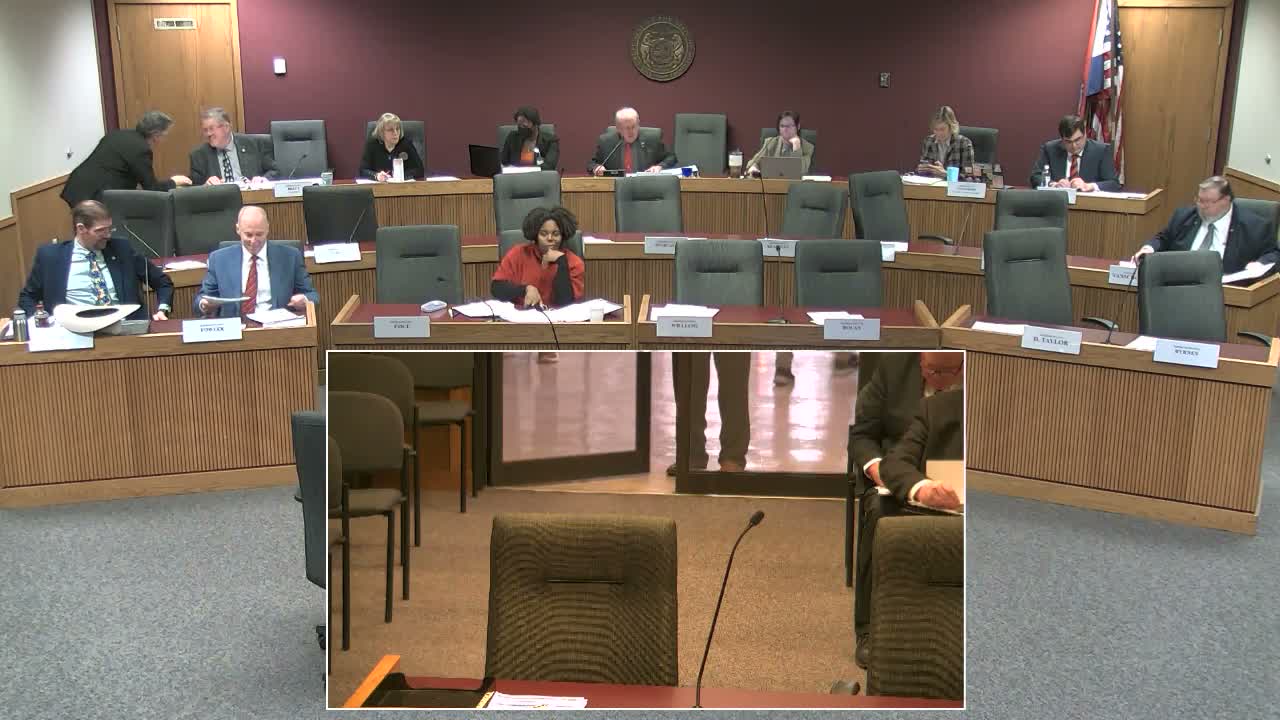
Summary
A special committee heard companion bills to require counties to calculate levies separately for residential, commercial, agricultural and personal property and a proposal to standardize ballot language showing tax impacts in dollars per $100,000 of assessed value. Proponents say the change protects homeowners from reassessment-driven tax shifts; election officials warned of ballot complexity.
A Special Committee on Property Tax Reform convened after the House Government Efficiency hearing and considered multiple measures intended to alter how local levies are calculated and how levy questions are presented to voters.
Representatives Roger Reedy and Dean Van Schleck presented companion bills (filed as HB 27-09 and HB 26-71 in testimony) that would require taxing jurisdictions to calculate levies separately for four subclasses of property ' residential, commercial, agricultural and personal property ' rather than blending all subclasses into a single aggregate rate. The sponsors said the change would prevent reassessment-driven "tax shifts" that can leave homeowners bearing a disproportionate share of local levies after a class-specific reassessment.
"Taxation by subclass will provide a more effective use of the Hancock amendment," said Kenny Moore, Boone County assessor and legislative chair of the Missouri State Assessors Association, who testified in support and provided a county example where residential reassessment raised residential class values more than the aggregate would show.
The committee then heard HB 29-25, sponsored by Rep. Ron Fowler, which would establish uniform ballot language for property-tax levy questions (a new statutory section, 115.706). Fowler said the standard language would require disclosure of who is taxing, the purpose and duration of the levy, debt status, and an estimated dollar impact shown as the cost per $100,000 of assessed value so voters can compare measures across jurisdictions.
Supporters and technical observers
Dan Hutton of the State Tax Commission supported the subclass approach as a way to reinvigorate voter protections and reduce unexpected tax shifts. School and local-government representatives said the bills can help but flagged potential revenue and equalization concerns.
Opposition and administrative concerns
Steve Hobbs of the Missouri Association of Counties testified in opposition to requiring all local tax measures be moved to November general elections and warned that many counties (particularly township counties with multiple special districts) could face a large increase in ballot styles and administrative burden. Election authorities cautioned that placing many local measures on the general-election ballot could lengthen ballots, increase voter fatigue and complicate poll-work staffing.
Committee discussion and next steps
Committee members debated whether limiting levy elections to general elections will increase turnout or overload poll workers. Sponsors signaled willingness to refine language and consider carve-outs for districts with special constitutional status, and assessors and the state tax commission offered to work on implementation and timing details. No committee vote was taken; further work and stakeholder meetings were anticipated.
Ending
The committee adjourned for the day after extended debate and testimony and scheduled follow-up work on implementation details, timelines and possible carve-outs.