Get Full Government Meeting Transcripts, Videos, & Alerts Forever!
Get email alerts on the Local Climate Action topic
No spam. Unsubscribe anytime.
Corte Madera climate committee selects tree planting, waste reduction, electrification and VMT as 2026 priorities
Summary
The Corte Madera Town Climate Action Committee narrowed its 2026 priorities to tree-planting/landscaping, waste-reduction outreach, electrification preparation (including heat-pump water heaters) and exploratory work on reducing vehicle miles traveled; small subgroups were formed to prepare workplans for the next meeting.
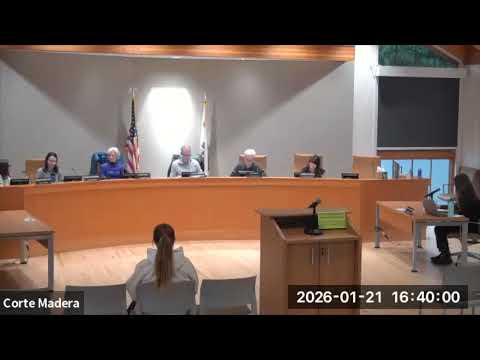
The Corte Madera Town Climate Action Committee voted informally on a slate of community-focused priorities for 2026 on the committee's meeting, settling on tree planting and landscaping, waste-reduction outreach, preparation for electrification and a targeted look at ways to reduce vehicle miles traveled.
Committee members said they wanted projects that yield measurable, community-facing results this year and can be implemented in partnership with schools, county programs and local service providers. "I would advocate for two topics that both of which I'd like to take part on ... electrification preparation," said a committee member who proposed folding heat-pump water-heater outreach into an electrification campaign, suggesting a postcard followed by a public workshop.
Student involvement featured heavily in discussion: several members said Redwood High School clubs could help with outreach and logistics for tree plantings and waste-reduction activities. A student member said the school’s mandatory class schedule and school TV are potential distribution channels for short educational segments and that drama and art students could help repurpose materials for upcycling projects.
On waste, members recommended clearer signage at public compost and recycling bins, school-based programs to collect hard-to-recycle items and partnering with county programs such as 0 Waste Marin or local refuse services for presentations. One member noted services like Ridwell could address hard-to-recycle streams such as plastic film and textiles.
Members also discussed the fire-safety tradeoffs that come with additional tree plantings and stressed the need to coordinate with fire and public-works guidance. "We have to be very, very careful about what you plant and where you plant it," a committee member said, urging staff and presenters to provide safe-species lists and Firewise guidance.
On vehicle miles traveled (VMT), the committee debated both neighborhood-focused tactics (e.g., encouraging residents to consolidate trips, merchant incentives) and commuter-focused strategies. Staff noted the town's current VMT data are modeled and that Transportation Authority of Marin (TAM) is updating models to give town-specific baselines, making a staff-supported research step useful before launching large campaigns.
To comply with the Brown Act, members agreed to split work into small subcommittees (kept below quorum) and to return to the full committee with concrete workplans and dates at the next meeting. The moderator asked volunteers to self-organize and bring back a plan, deliverable dates and proposed outreach materials at the February meeting.
A regional climate organizer who phoned in, Jody Tim, chair of the Fairfax Climate Action Committee, urged committees across the county to prepare for electrification and promoted regional coordination on outreach on heat-pump water heaters. "There won't be gas water heaters available for most single family homes that wanna move in that direction," Tim said, urging local committees to align with expected regional PR efforts.
Next steps: leads for the landscaping, tree planting, waste and electrification subgroups will meet (with subgroups kept below a quorum or publicly noticed) and return with workplans and suggested dates at the next monthly meeting. Staff offered to arrange presentations from county partners and local service providers on waste programs and other topics.
The committee adjourned after scheduling the next check-in and asking subgroup leads to present action plans for committee review.