Senate committee holds proposed sobriety‑checkpoint fund after lawmakers press for data on fines and operations
Loading...
Summary
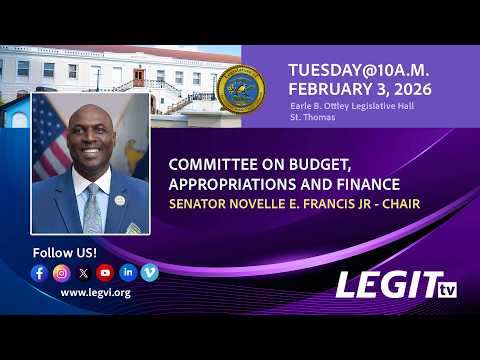
Lawmakers pressed VIPD and finance officials for precise data on checkpoints, arrests, and where fines currently flow before deciding whether to create a non‑lapsing sobriety checkpoint safety fund; the committee voted to hold Bill No. 36‑0221 for further review and data collection.
The Committee on Budget, Appropriations and Finance heard testimony on Bill No. 36‑0221, which would create an "Impaired Driving and Highway Sobriety Checkpoint Program Safety Fund" to finance sobriety checkpoints and highway‑safety initiatives. After extended questioning about where fine revenue currently goes and how many checkpoints and arrests are conducted, the committee voted to hold the bill for further review.
Clarina Mudez Elliott, executive assistant commissioner at the Department of Finance, told the committee the bill "represents a thoughtful and necessary step" to address impaired driving and would establish a dedicated, non‑lapsing fund tied to fines under Title 20 §493. "The creation of a dedicated fund strengthens fiscal transparency by directly linking fine revenues to impaired driving enforcement and highway safety expenditures," Elliott said. She recommended formal interagency memoranda of understanding to define roles, accounting controls, and reporting protocols.
Daphne O'Neil, director of the Office of Highway Safety for the Virgin Islands Police Department (VIPD), testified the bill would require at least 12 sobriety checkpoints territory‑wide each year, with island minimums. "When established, the fund will support traffic control operations, the dedicated sobriety checkpoint program, and augment funding for the programs approved in the Office of Highway Safety annual traffic safety plans," O'Neil said. She presented territory data showing declines in impaired‑driving crashes from FY2023 to FY2025 but emphasized that fatalities remain a concern.
Lawmakers pressed witnesses on operational and fiscal details. Senators raised concerns about whether enforcement quotas would follow from the statutory minimums; Sergeant Arthur Joseph, St. Croix traffic commander, and Sergeant Joycelyn Lee Bob, St. Thomas–St. John traffic commander, answered that officers "tend to stay away from quotas" and that checkpoints are planned using data and seasonal event calendars. On checkpoint counts and arrests, the director corrected an initial figure after committee members noted a mismatch: she clarified that in FY2025 VIPD recorded 56 checkpoint days on St. Thomas–St. John and 140 days on St. Croix, and that arrest and checkpoint tallies had been conflated in earlier answers.
Members also sought clarity on where current fine revenue is deposited. Witnesses said citation and fine proceeds are currently split among the courts, the VIPD and the Justice Department in various ways; both Finance and VIPD recommended a three‑year review of court and finance records to estimate potential fund receipts before redirecting fines into the new fund. O'Neil said the fund could be seeded with prior‑year revenues if enacted.
Committee members also asked about federal grant interactions and recurring carryovers. O'Neil described NHTSA grant timing and said federal funds typically pay overtime for enforcement initiatives and may require prior approval for equipment; she estimated carryovers at roughly $200,000–$300,000 in recent years. The Office of Highway Safety reported $194,799.14 in overtime spending through traffic enforcement in the most recent reporting period.
After discussion, the committee agreed to hold Bill No. 36‑0221 for additional fiscal and operational review and asked staff to collect three years of court and finance data on fines and the distribution of citation revenues. The committee did not take final action on the measure at the hearing; the chair ordered the bill held in committee until the call of the chair.
Next steps: staff were asked to obtain three years of court and Department of Finance records on fines under Title 20 §493 and to return the bill to committee once the financial analysis and recommended interagency agreements are available.