Get Full Government Meeting Transcripts, Videos, & Alerts Forever!
Get email alerts on the Housing Corridor Study topic
No spam. Unsubscribe anytime.
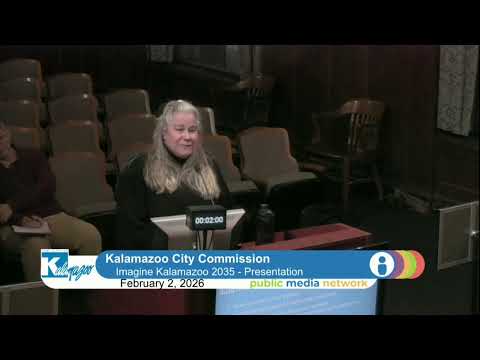
Kalamazoo officials review corridor study that maps infill housing opportunities and revenue gains
Summary
Consultants presented a housing-corridor study showing underutilized parcels along Kalamazoo corridors that could yield hundreds of homes and millions in new taxable value; commissioners asked about tax impacts, financing and protections for longtime homeowners. No policy was adopted; the study will be incorporated into the Imagine Kalamazoo 2035 master plan as a reference.
City leaders on Monday heard an informational presentation on a county‑sponsored "housing corridor" study that maps underutilized parcels across Kalamazoo and models how infill development could increase housing choice and local tax revenue.
The study, presented by Sherilyn Parsons, Community Development Manager, and Ryan Kilpatrick of Flywheel Community Development Services, is intended as an educational tool to be incorporated into the Imagine Kalamazoo 2035 master plan. Parsons emphasized the study does not represent city‑led development or city‑owned properties, and that mapped parcels are examples for private developers to consider.
Kilpatrick told commissioners the goal is to use existing infrastructure more efficiently and create housing across the spectrum. He cited county analysis showing large unmet demand—about 7,800 additional units needed by 2030 and roughly 15,000 more by 2050—and argued corridors can generate more taxable value per acre than suburban development. "Downtown Kalamazoo is generating vastly more tax revenue on a per acre basis than any place else in Kalamazoo County," Kilpatrick said, and contrasted that with the lower per‑acre returns of low‑density subdivisions.
The presentation included three illustrative redevelopment concepts. For example, an illustration at Lovers Lane and East Cork suggested roughly 97 new households could be created and that the change could generate about $18 million in new taxable value above current conditions. Kilpatrick emphasized these were illustrative scenarios intended to show potential tax and housing impacts, not formal proposals.
Commissioners sought details on protections and tradeoffs. Commissioner Hoffman asked how long‑term homeowners would be protected from rising property taxes; Kilpatrick pointed to the "Headley amendment" cap on annual taxable value increases and noted tools such as the Neighborhood Enterprise Zone, brownfield tax increment financing and targeted abatements that can offset tax impacts for some homeowners. He also suggested legal tools—such as placing a house in a living trust—can preserve tax status across generations.
Several commissioners raised implementation questions: how the city would recruit and support developers, whether the city has capacity to shepherd early projects and how to finance mixed‑use ground floors that can be hard to lease. Kilpatrick recommended preapproved plans for small‑scale developers, aligning public infrastructure investment with private projects, and using "impact capital" willing to invest over longer time horizons so early phases can be subsidized until market momentum builds. He also said the team would look at incentives for higher environmental performance, noting LEED and similar programs could be layered into incentives.
Commissioners also pressed the study’s equity implications. One commissioner cautioned that transfers on death can "uncap" taxable value in Michigan and that gentrification can affect families’ ability to pass homes to heirs; staff and the presenter discussed outreach and legal strategies to help homeowners keep homes affordable for family members.
Staff said the corridor study will be posted to the city website and used as a reference in the City’s master plan process; there was no request for immediate action or formal vote on the study. The meeting moved on to other items and adjourned prior to the 7:00 p.m. business session.
Next steps: the study will be incorporated into the Imagine Kalamazoo 2035 master plan materials and staff indicated they will correct minor data labeling and finalize maps before posting. Commissioners requested follow‑up conversations about financing strategies, workforce and small‑developer incubation, and use of the city’s existing tools (including TIF/Northside Cultural Business District Authority) to target infrastructure investments that would catalyze private development.