Get Full Government Meeting Transcripts, Videos, & Alerts Forever!
Get email alerts on the Land Use topic
No spam. Unsubscribe anytime.
Sioux Falls council rezones land for Gemini data center; preliminary plan approved after water-use amendment
Summary
After more than three hours of public comment, the Sioux Falls City Council approved rezoning for a planned Gemini data center and later approved its preliminary subdivision plan only after adding a condition limiting potable water by meter size. Residents raised concerns about water, power, noise and local benefits.
Sioux Falls — The Sioux Falls City Council on Jan. 6 approved a rezoning request for a proposed Gemini data center campus and, after initial resistance and a subsequent amendment, approved the project's preliminary subdivision plan.
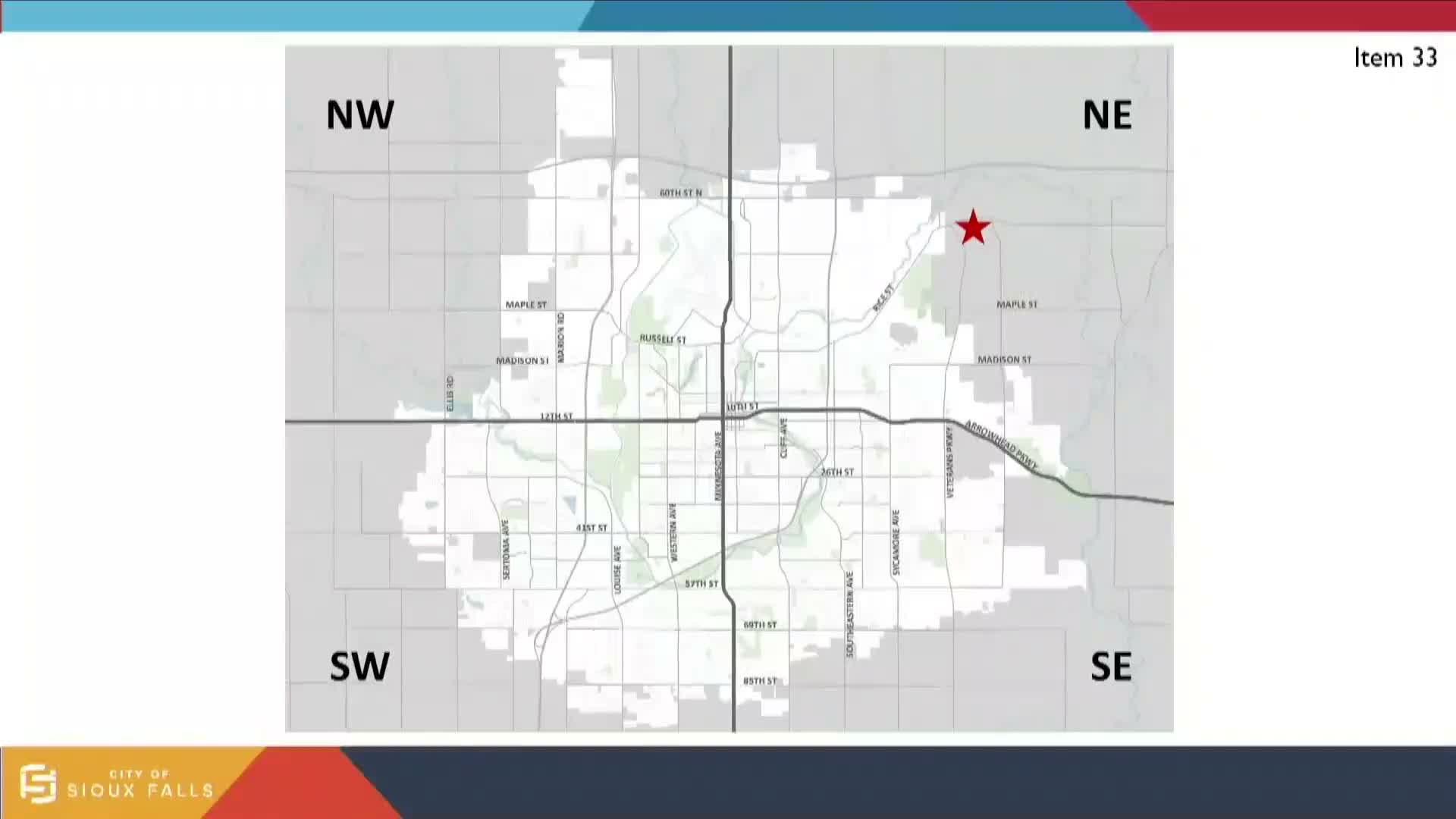
The council unanimously approved the rezoning ordinance for the Gemini site (Item 33) following presentations from planning and public works staff and extensive public comment. The vote on the rezoning was recorded as 7–0.
The matter drew a long public comment period focused on water and energy use, noise, local economic benefits and developer transparency. “This facility is projected to more than double our entire city's energy consumption,” said Kelsey Hart, a Sioux Falls resident, urging the council to vote no. Other residents cited examples from other states alleging higher electricity bills, large water withdrawals and limited long-term local jobs.
Supporters argued the council’s role at the hearing stage was to judge land use, not operational details. Bob Muntin, president and CEO of the Sioux Falls Development Foundation, told the council the rezoning was one step in a larger process and said the applicants were following city protocols; he added that such projects can generate substantial property and utility tax revenue and construction jobs during the build phase.
Developers and staff answered technical questions. Mark Cotter of Public Works said the applicant is expected to design utilities to an advanced level of detail, secure easements and pay for utility extensions without reimbursement. Michael Anvar, who represented Gemini, said Gemini is a U.S.-owned family office and that the company would be the developer, not necessarily the eventual operator; he said utility build-out costs would fall on the developer and that end-user details remain to be finalized.
When the council considered the preliminary subdivision plan (Item 39), the initial motion to approve failed 4–3. Councilors voting in opposition cited lingering concerns about the operational impacts and the need for clearer, enforceable constraints on water and power use.
Council later voted 7–0 to reconsider the preliminary plan. During the reopening the council approved an amendment — by a 4–3 vote — limiting potable water to “domestic use as determined by meter size,” a mechanism staff said can cap the amount of city-supplied potable water available for cooling or other large uses. Staff explained meter size and building fixture counts would be reviewed during building permitting and would determine the permitted potable-water flow. After the amendment, the council approved the preliminary plan as amended, 7–0.
Council and utility staff discussed oversight and safeguards. A representative from the utility sector explained that power service requires system impact studies and that large customers typically must pay for transmission and interconnection work. The council was told that state regulation of rates and cross-subsidization is administered by the Public Utilities Commission and that customers must follow negotiated service agreements.
The council directed that the water limitation be recorded as part of the preliminary plan; staff said final meter sizing will be set during permitting, and that the developer would be required to meet all applicable environmental and code standards.
What happens next
With the rezoning and preliminary plan approved, the project moves into more detailed engineering, permitting and review of building plans. City staff said developers must bring utility designs to the level required for construction, secure easements and obtain any necessary regulatory approvals before construction begins. The council’s action on the preliminary plan included the meter-size limitation as a condition; staff said they will review fixture counts, meter sizing and final technical plans through the standard permitting process.
Vote tallies and procedural notes
- Rezoning (Item 33): approved 7–0. - Preliminary plan (Item 39): initial approval failed 4–3; motion to reconsider passed 7–0; amendment limiting potable water by meter size passed 4–3; final approval of the preliminary plan as amended passed 7–0.
Reporting notes
Attributable quotes in this story come from the public transcript of the Jan. 6 Sioux Falls City Council meeting and are identified by speaker names as they appeared in the transcript. Claims about energy and water usage made by public speakers reflect projections or sources they cited during testimony; those technical claims were disputed in the meeting and have not been independently verified in this article.
The council will continue to consider detailed engineering and permitting filings before any construction starts.