
Board hears first read of state-aligned preK–3 promotion and retention policy
Get AI-powered insights, summaries, and transcripts
Sign Up Free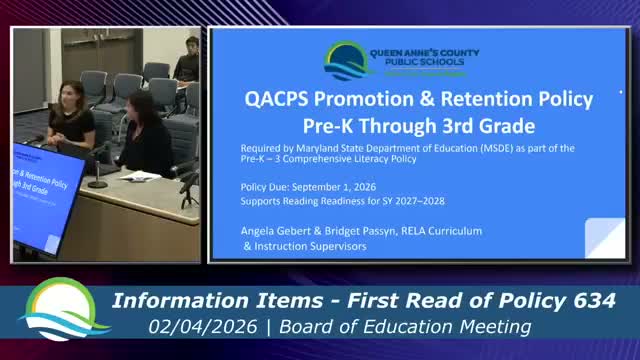
Summary
Board members received a first‑read presentation on a promotion and retention policy aligned with MSDE’s comprehensive literacy policy; implementation will require student reading improvement plans, supplemental supports, and additional staffing and funding to provide tiered interventions.
The Queen Anne's County Board of Education received a first read of a promotion and retention policy for preK through third grade that aligns with the Maryland State Department of Education’s comprehensive literacy guidance.
Bridget Passon, English language arts supervisor for grades 3–12, and Angela Geebert, supervisor of instruction for early childhood and ELA preK–2, presented the policy’s key elements: educator training in the science of reading, literacy coaching, an assessment framework that combines state tests and local triangulated data, required student reading improvement plans for any preK–3 student not reading on grade level, and parent notification processes. The presenters emphasized that the state requires student reading improvement plans beginning with the 2027–28 school year and that schools must offer intensive tiered supports when retention is under consideration.
Board members pressed for details on implementation costs, how many students might face retention under current measures (presenters estimated roughly 15–20 third graders per school using current I-Ready data), and how many reading specialists the district would need (discussion ranged from dozens to roughly 40–50 to fully staff intensive interventions). Presenters noted the district received a ‘Read and Lead’ grant (~$173,000) used to purchase instructional materials, but they said the grant covered supplies rather than recurring salaries for reading specialists.
The policy was presented for information as a first read and will return to the board for additional review; administrators said they will bring a second read and proposed edits in March and April with public input to follow. Board members voiced support for early parent outreach and literacy nights to explain the changes and for continuing to track implementation costs and staffing needs.