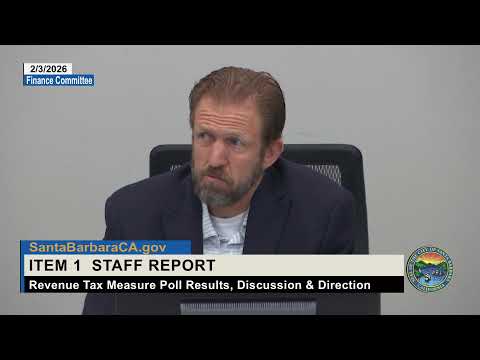
Finance committee forwards plan to explore a real property transfer tax after polling shows limited paths to two-thirds support
Loading...
Summary
City staff presented December 2025 polling showing majority support for a transient occupancy tax (TOT) increase and rising support for a transfer tax after messaging, but neither measure reached the two-thirds threshold required for a special tax; the finance committee voted unanimously to forward staffrecommendation to the full City Council to pursue outreach and further analysis of a real property transfer tax.
City staff and an outside pollster presented December 2025 survey results to the Santa Barbara City Finance Committee on Feb. 3, then the committee voted unanimously to send staffrecommendation to the full City Council to pursue further analysis and outreach on a proposed real property transfer tax.
"We are facing an approximate $6,000,000 general fund operating deficit in this current fiscal year, fiscal year 2026, and that deficit grows to $10,400,000 in fiscal year 2027," Finance Director Keith Demartini told the committee as he introduced the polling results. Staff framed the polling as part of options to close an anticipated budget gap.
Adam of FM3 Research, the pollster the city retained, said the survey (520 interviews, conducted Dec. 4—) targeted likely November 2026 voters and reported a full-sample margin of error of about +/-4.5 percentage points. FM3 tested two housing-related funding mechanisms: a transient occupancy tax (TOT) increase from 12% to 14% estimated to raise about $5.8 million annually, and a real property transfer tax of $9.50 per $1,000 on sales/transfers over $3 million estimated to raise about $5.1 million annually. A tested $49 parcel tax for libraries (3% annual adjustment) was also tested and estimated to generate about $1.3 million.
FM3 said baseline support for the TOT was roughly 57% yes / 31% no (12% undecided). The transfer tax initially polled lower (about 42% yes / 33% no with 26% undecided), but support rose after explanatory messaging: FM3 reported the transfer tax moving to about 61% yes / 28% no with 11% undecided. The firm cautioned that neither measure reached the two-thirds approval threshold required for a special tax and that simulated organized opposition substantially reduced support for both measures; in one opposition scenario the transfer tax fell to roughly 50% yes / 32% no with about 17% undecided.
Committee members and staff discussed what the city can and cannot do during the pre-election period. "The city cannot advocate for these measures itself," staff said; it can, however, provide informational materials explaining mechanics and impacts. Staff recommended an informational outreach program, stakeholder engagement (including planned meetings with realtors and tourism partners), and a tracking poll in May or June before the council would consider placing a measure on the November ballot.
During public comment, Rob Fredericks, speaking from the perspective of the Housing Authority, urged the city to secure predictable, ongoing housing revenue and warned that a city-led two-thirds measure would be difficult to qualify, fundraise for and pass by November 2026. Fredericks recommended including a citizen oversight committee modeled on the Measure C structure for transparency and trust.
Kathy Jenega Dykes, president and CEO of VISIT Santa Barbara, presented a tourism-industry analysis (commissioned from Tourism Economics) that estimated a 14% TOT could reduce hotel demand by roughly 10,000 room nights and could lower total local sales by about $15 million, affecting tourism-supported jobs and small businesses; she urged caution about raising the TOT for its potential ripple effects on the local economy.
Committee members asked for more detail on who would pay the transfer tax (staff said it would be charged to sellers in escrow for transactions above $3 million), whether commercial transfers were included (staff modeled all property types in the revenue projection), and how the city would show accountability if it adopted a general tax. Staff described options such as holding funds in a separate account, annual reporting to council or finance committee, and the possibility of folding oversight into the existing Measure C oversight structure rather than creating a separate body.
Chair Friedman moved to approve the staff recommendation to forward the polling results and direction to explore a real property transfer tax to the full City Council. The motion, moved by Council member Santa Maria and seconded by Committee member Harmon, passed unanimously by those present.
The next procedural steps: staff will present the polling results and recommendation to the full City Council on March 3; if council concurs, staff will conduct outreach, stakeholder meetings and a tracking poll in May or June and return to council — likely in July — with the tracking poll and outreach outcomes to ask whether to place a measure on the November 2026 ballot. Staff told the committee the city budget is being prepared without assuming any revenue from a potential measure; if adopted by voters, a transfer tax would take effect Jan. 1, 2027, producing a half-year of revenue in FY2027.