Get Full Government Meeting Transcripts, Videos, & Alerts Forever!
Get email alerts on the Downtown Redevelopment topic
No spam. Unsubscribe anytime.
Smyrna council adopts downtown redevelopment plan after yearlong public process
Summary
The Smyrna City Council voted to adopt the Smyrna Downtown Redevelopment Plan (Resolution 2026-005) after a presentation by MKSK, public comment from residents and council discussion about procurement, phasing and design priorities.
Smyrna — After a year of public engagement, the Smyrna City Council voted to adopt the Smyrna Downtown Redevelopment Plan and authorized the mayor to execute related documents.
MKSK, the urban design firm that led the process, presented a preferred concept for the First Baptist Church site that centers on preserving the historic chapel, creating a connected public-realm called the "Jonquil Mile," and adding mixed uses to extend downtown. The firm said the plan resulted from three phases of work and multiple public meetings and outreach tools. "This is a presentation of the Smyrna Downtown Development Plan," the consultant told the council, adding that a 100-page plan with visuals and an implementation chapter is available online.
Why it matters: Council members and the consultant emphasized that the project is intended to double the walkable core of downtown over time, anchor redevelopment around the preserved chapel and new public green, and support ground-floor retail and dining that residents said they wanted. Councilman Lindley said the effort represented an unprecedented amount of resident engagement and called the plan "a concept that will set the course for the next 50 to 100 years." He moved to adopt the plan, and Council member Welch seconded the motion.
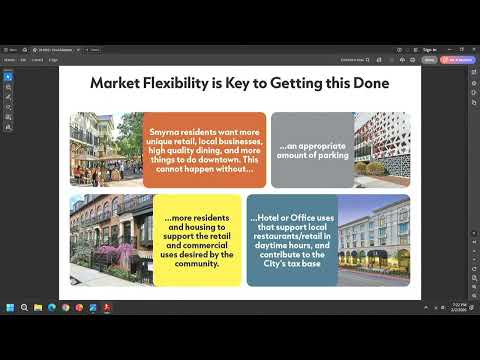
What the plan proposes: MKSK presented conceptual figures including roughly 350 new housing units (a mix of for-sale townhomes and for-rent flats and apartments), space for about 8–12 businesses, a food hall with 4–6 restaurants and a hotel of about 120 rooms. The consultant also described public-realm elements including a one‑acre Chapel Green and roughly 2 acres of new, smaller public greens and pocket parks to connect the site to Market Village, the Village Green and other civic anchors.
Public input and concerns: MKSK reported strong outreach — three in-person community meetings (the third with about 150 attendees), two online surveys totalling about 3,200 responses, and about 13,000 unique visitors to the project website — which the firm said added up to roughly 17,000 engagements over the project year. Residents who spoke during the council meeting praised the process but raised concerns about tree preservation, traffic and how the work will be phased. Marie Smith, a resident, said the project "looks great" but urged the city to retain mature trees for shade. Sean Murphy asked whether the redevelopment would be built as a single large project or phased; staff said phasing has not yet been decided.
Implementation and procurement: The presentation and staff recommended advancing the project through a solicitation process: an RFQ to shortlist qualified developers followed by an RFP and, later, negotiation with a selected partner. Staff recommended embedding community expectations (local business prioritization, high-quality architecture, a mix of housing types, and publicly accessible greens) into procurement scoring and suggested the city may retain a real-estate adviser to help with the RFQ/RFP. The consultant suggested a phased timeline (short-term actions under a year; medium-term 1–3 years; long-term 3–5 years) and noted some public-realm improvements could be implemented early.
Council action and vote: The council placed adoption of Resolution 2026-005 (authorization to adopt the Smyrna Downtown Redevelopment Plan 2026 and to authorize the mayor to sign and execute related documents) as its first action item. Councilman Lindley moved to approve and Council member Welch seconded. The transcript records Council member Hines voting "in the affirmative"; the motion was carried and council moved on to other business.
What’s next: Staff indicated further front-end work and outreach before issuing an RFQ/RFP, with a likely timeline targeting mid‑year to begin formal solicitation. Council members thanked staff, the consultant team (MKSK), the Downtown Redevelopment Committee and plan ambassadors for their contributions.
Note on spelling and transcript variants: The consultant and meeting transcript used multiple spellings for the trail concept ("Jonkul/Johnco/Jonquil"). This article uses "Jonquil Mile" as the normalized name of the proposed linear public-realm.