Charlottesville staff outline PPAs to put solar on two schools, warn of tight federal tax-credit deadlines
Loading...
Summary
City staff and Madison Energy presented power purchase agreement proposals for Charlottesville High and Middle schools, saying preliminary agreements could avoid nearly $4 million in electricity costs over 25 years but must meet 2026–2027 federal tax-credit deadlines; school-board and council approvals are next steps.
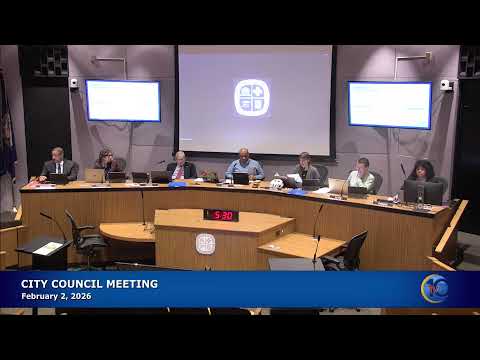
City of Charlottesville sustainability staff on Feb. 2 told the City Council they have preliminary power purchase agreement proposals to install large solar systems on Charlottesville High School and Charlottesville Middle School and urged prompt action to qualify for federal investment tax credits.
"A PPA is a contract between a power producer… and a buyer," said Crystal Rittervold, director of the Office of Sustainability, describing a structure in which a developer finances and operates a system on public property and the site owner buys the electricity at a negotiated rate. Rittervold said the projects would require no upfront capital from the city or school system while allowing developers to claim tax credits.
Why it matters: Rittervold said the combined preliminary proposals for the two sites are projected to start saving money in year one and to yield nearly $4,000,000 in avoided electricity costs over a proposed 25-year term. She added that an early-2026 construction-start deadline in federal legislation (HR 1, passed in 2025) means the city and its partners must move quickly to preserve tax-credit eligibility.
Officials and the developer discussed technical and scheduling risks. Madison Energy representative Megan Milo said the company has "a plan" plus contingencies, including staged procurement of equipment and a stock of eligible solar modules that can be allocated to the projects to meet safe-harbor requirements if grid upgrades slip. "We're gonna work the plan, and then we have a backup plan and a backup backup plan," Milo said.
Rittervold said Charlottesville has used a cooperative procurement vehicle that allowed staff to solicit preliminary proposals quickly and that Dominion Energy — the local distribution utility — has completed grid studies for both sites and must authorize any required grid upgrades. Rittervold also noted an important ownership detail: Charlottesville High School is owned by the school board and the middle school is owned by the city, so each site-owner party will need to sign site-access agreements or PPAs as appropriate.
Councilors asked whether PPA rates are tied to Dominion's rates; staff and Madison Energy said the negotiated PPA rate is independent of the utility tariff and is instead driven by project cost, contract terms and an agreed escalation schedule. Madison indicated it typically offers weather‑adjusted performance guarantees and that its payment is tied to actual energy delivered, which helps align incentives for production.
Rittervold said the school board will receive a presentation later in the month, and the school‑board and city approvals are prerequisites for Dominion to start grid upgrades and for the projects to proceed. No council vote on a PPA occurred at the Feb. 2 meeting; staff asked councilors to note the timeline and to anticipate formal actions by the board and council once negotiations and project engineering advance.
Next steps: school-board consideration of the Charlottesville High School agreements in March–April, continued negotiations and engineering by the developer, and authorization for Dominion to proceed with grid upgrades once required agreements are executed.