
Senate panel rejects growth-funding request for KANW public radio after debate over funding mechanism
Get AI-powered insights, summaries, and transcripts
Subscribe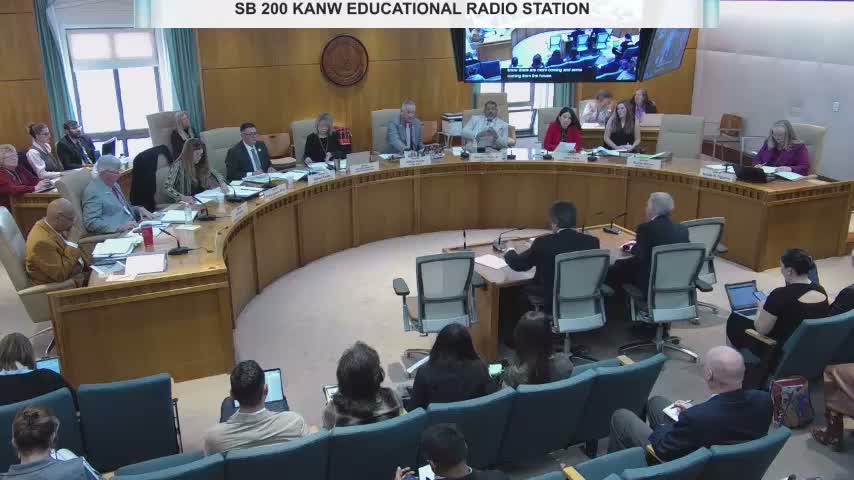
Summary
The Senate Education Committee rejected a funding request to backfill lost federal public radio support and to fund translator filings for KANW; committee debate focused on whether the proposal should use growth (nonrecurring) funds, capital outlay, or finance-committee allocations; the motion failed in committee by a reported 3–5 vote.
Senators debated a funding request to support KANW public radio and its statewide translator work, but the Senate Education Committee did not approve the appropriation request in committee.
KANW general manager Michael Brasher described the station's long service and emergency-alert role and said the station had been included in a federal clawback and faces an additional unfunded year of lost federal support; he said the requested funds would help file for translator frequencies and sustain service to underserved communities. "K and W is the most listened to radio station in the entire state of New Mexico," a station representative told the committee, noting cultural programming and statewide reach.
Why it mattered: Testimony from public-radio staff emphasized local news, cultural programming, and the station's emergency-alert function. Opponents and skeptical senators focused on the funding mechanism: several members argued the request resembled recurring operational funding and questioned whether growth (nonrecurring) funds were the right vehicle, stressing that finance-committee allocations and capital-outlay processes are typical paths for larger grants.
Key points in committee: Senators pressed why the station's equipment and translator work were being handled through growth funding rather than capital or other standard mechanisms and whether prior backfill actions (special session funding) had left gaps. Brasher and the sponsor said some federal support had been restored in earlier actions but that a second year remained unfunded and the requested nonrecurring money would bridge the gap and enable filings for translators.
Committee action: A do-pass motion on the appropriation request was moved and seconded; after debate the motion failed in committee by a reported vote of 3—5.
Next steps: Because the committee did not approve the request, KANW's sponsors said they would continue to pursue other sources, including capital-outlay allocations, grow fund mechanisms at larger scale, and federal or private support to sustain translator applications and statewide service.