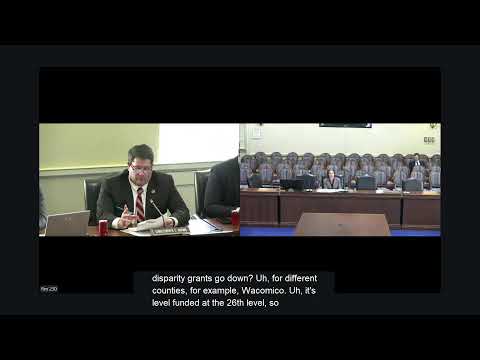
DLS briefing to Economic Matters Committee flags $1.4 billion federal-revenue uncertainty, outlines fund shifts
Loading...
Summary
At an Economic Matters Committee briefing, DLS budget manager Tanya Zimmerman outlined the governor's proposed budget — noting modest near-term balances, major special‑fund transfers (some replaced by bonds), spending reductions contingent on legislation, and an Office of Legislative Audits finding of roughly $1.4 billion in unsupported federal revenue at MDOT.
Tanya Zimmerman, operating budget manager for the Department of Legislative Services, told the Economic Matters Committee that the governor’s proposed budget leaves a modest general fund balance but shifts large sums across fund sources and contains notable fiscal risks, including an audit-flagged $1.4 billion in federal revenue documentation for the Maryland Department of Transportation.
Zimmerman summarized the administration’s plan as leaving an approximately $108 million general fund balance at the end of fiscal 2027 and an estimated rainy day fund of about $2.17 billion (roughly 8 percent of general‑fund revenue). She said the overall budget plan increases by roughly $5 million but that the change “varies by fund source,” with general funds and special funds moving in different directions.
Why it matters: committee members pressed DLS on the composition and durability of the plan — in particular, whether budget fixes rely on one‑time transfers, bond replacements, or ongoing spending changes that shift costs to local governments. Members also sought clarity on audit findings that could expose the state to future liabilities and on how the budget treats SNAP penalties, pension cost shifts and capital PAYGO reductions.
Key numbers and proposals Zimmeran said special funds increase by about $974 million, driven mainly by $357 million tied to the Blueprint for Maryland’s Future education fund, roughly $287 million for transportation, and about $70 million to administer the paid‑leave program. She identified about $586 million in transfers to the general fund — including roughly $292 million from the Strategic Energy Investment Fund and about $188 million from the fiscal responsibility fund — and said some transfers (for example, the Bay Restoration Fund and Waterway Improvement Fund) would be backfilled with general‑obligation bonds.
The briefing highlights roughly $593 million of spending reductions contingent on legislation and additional non‑legislative cost‑containment in areas such as the developmental disabilities administration. Zimmerman said the structural budget shortfall looks modest in the near term (reduced to about $394 million in fiscal 2027) but grows in the out years — to about $2.3 billion in fiscal 2028 and roughly $4.1 billion by fiscal 2031 — driven by employee compensation, teacher retirement and human‑services costs.
Audit finding and member concerns Zimmerman told members that the Office of Legislative Audits had identified about $1.4 billion in federal revenue that the Maryland Department of Transportation had assumed without supporting documentation, and that that gap could require state funds to backfill some portion. Representative questions were direct: “how do we your mark $1,400,000,000 is due from the federal government, but the federal government doesn't know anything about it,” one delegate asked, pressing whether the discrepancy reflects an accounting error or potential misuse; Zimmerman said the department would be better positioned to explain the underlying causes and that agencies are working to determine how much of the amount may be receivable from the federal government.
Local impacts and program exposures Multiple delegates asked whether reductions in state pension contributions and other items amount to shifting costs to local jurisdictions; Zimmerman confirmed localities would pick up the commensurate share of reduced state retirement contributions. She also said the budget includes funding to pay certain SNAP payment‑error penalties and described a forthcoming cost‑share requirement under recent federal rules that could begin in federal fiscal 2028 if error rates remain high.
Follow up and next steps Committee members repeatedly requested written follow‑up on PAYGO remaining in the capital budget, the composition of spending reductions versus transfers, the specific uses of strategic energy funds, and a detailed reconciliation of the differing figures presented across briefing pages. Madam Chair asked DLS to provide answers when available. The meeting recessed for five minutes to make technical changes before the next briefing.
Sources and attribution All quotes and figures above are drawn from the Department of Legislative Services fiscal briefing presented by Tanya Zimmerman and the subsequent member Q&A recorded in the committee transcript. Direct questions and requests for follow‑up were raised by members identified in the transcript as delegates.