DOC tells senators funding to reach 1:11 correction‑officer ratio requires funding for roughly 890 COs
Loading...
Summary
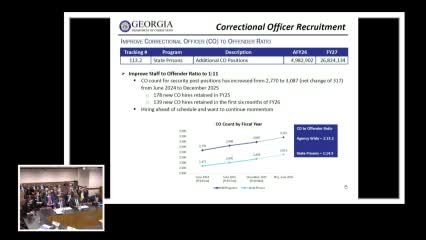
DOC told the Senate subcommittee the governor’s recommendation aims to fund existing filled slots and promotions so Georgia can approach a 1:11 CO‑to‑inmate ratio, estimating about 890 additional funded field positions are necessary; senators pressed on how DOC is paying currently filled but unfunded slots with agency revenue.
The Georgia Department of Corrections told the Senate appropriations subcommittee that funding in the governor’s amended budget is aimed at moving toward a 1:11 correction‑officer ratio used as a benchmark by Guidehouse. DOC said it does not seek new state slots but wants to fully fund existing filled positions and account for anticipated promotions and step increases.
DOC estimated the state would need roughly 890 additional funded field positions to achieve the 1:11 ratio. "We need 890 additional field positions... to get us to 1 to 11," DOC staff said. The governor recommended $4.9 million for the staffing change; committee testimony noted the House increased that line to roughly $9.7 million.
Committee members pressed DOC on its current practice of paying filled but unfunded slots from agency revenue. DOC staff said these "other funds" include revenue from work details, telephone commissions and commissary sales and that certain revenues (for example, proceeds from a Braille unit) are restricted to their statutory purposes. Senators asked for clearer accounting of how those revenues are tracked and used; DOC said the department’s budgeting and accounting teams allocate agency receipts to areas with deficits and that the agency will provide more detailed tracking information on request.
Senators also raised retention and compensation questions. DOC described entry and step increases (examples cited in testimony: medium‑security CO1 starting at $45,000 moving toward $50,000 at CO2; close‑security CO1 starting at $50,000 with increases thereafter) and said promotions and step increases are tied to performance. DOC said pay comparisons across county jails and neighboring states will be provided to ensure equitable recruitment and retention strategies.
Committee members requested follow‑up materials, including precise vacancy and funded‑slot counts, the detailed cost to reach the 1:11 ratio, and comparisons of total compensation packages (salary plus retirement benefits) with local and regional employers. No vote was taken; members indicated staffing funding will remain a core negotiation point in final budget talks.