Wyandotte County opens public hearing on STAR bonds for proposed Chiefs stadium as residents demand enforceable benefits and fiscal protections
Loading...
Summary
Wyandotte County held a Feb. 3 public hearing on whether to pledge local sales and transient guest tax as incremental revenue for STAR bonds tied to a proposed Chiefs NFL stadium. Outside counsel outlined the proposal and deadlines; residents urged stronger protections for taxes, transparency and binding community benefits. Commissioners said they will seek more answers at the Feb. 6 meeting.
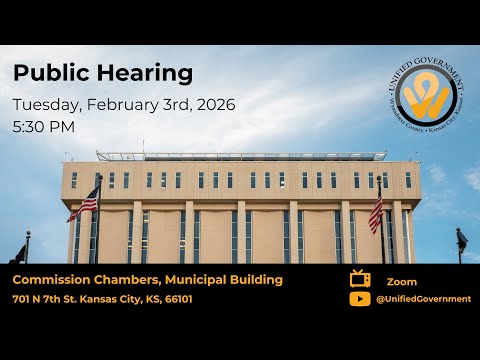
Wyandotte County officials opened a public hearing on Feb. 3 to consider an ordinance that would allow the county to pledge local sales and transient guest tax as the source of payment for STAR bonds related to a proposed Chiefs NFL stadium and entertainment district. Outside legal counsel Todd LaSalle, representing the Unified Government, presented the project overview and the timetable for decisions, and the commission then heard more than two hours of public comment that ranged from enthusiastic support for local jobs to urgent warnings about long-term fiscal risk.
LaSalle told the commission the project as discussed in term sheets includes a domed stadium described in the presentation as roughly 65,000 seats and a stadium construction budget cited in the slide deck at about $3,000,000,000; ancillary development and an entertainment district were also described. He said state statute gives the local government 60 days from the December 22 announcement to decide whether to pledge an increment, and the presentation listed a local decision deadline of Feb. 20, 2026; other dates mentioned included a term-sheet site-control target of May 15, 2026 and document completion by Oct. 1, 2026. LaSalle said the Kansas Development Finance Authority (KDFA) is likely to issue the STAR bonds and that, under the structure described, the Unified Government would not be the issuer or guarantor of the bonds.
On what the commission would be asked to pledge, LaSalle described the request as limited to the increment generated inside the STAR bond district: the city’s 1% sales and use tax portion (to the extent it is not otherwise committed), the county’s share of the county sales tax (as described in the presentation), and up to 8% of the unified government’s transient guest tax (TGT) generated within the district, with several dedicated levies explicitly excluded (an EMS sales tax and a public safety/neighborhood infrastructure sales tax, among others). LaSalle also summarized draft ordinance conditions that would require the STAR bond district boundaries in Wyandotte County to match the project area, preserve the UG’s approval rights for enlargement of the district, make the pledge subject to satisfactory definitive documents, and require a UG-appointed representative on a community-benefits committee. The presentation listed an outside date for bonds issuance tied to the pledge (stated as Dec. 31, 2030 in the slides).
Public comment was extensive and sharply divided. Supporters — including trade union leaders and some business speakers — argued the stadium and related development would create construction and permanent jobs and catalyze regional economic activity. Opponents and cautious residents raised recurring concerns: that the district might include areas already producing tax revenue, that long-term commitments could reduce local capacity to pay for schools, roads and public safety, and that the county lacks sufficient enforceable guarantees that promised community benefits will reach East Side neighborhoods and longtime residents. Several speakers asked for firm caps, independent annual audits with consequences if promises are unmet, clearer local contracting and hiring rules, and protections against displacement and higher property tax burdens for residents near the site.
Speakers repeatedly criticized the secrecy of earlier negotiations, including nondisclosure agreements presented to commissioners, and asked the commission to post presentation materials and provide fuller documentation. Several residents urged the commission to "say no" as a negotiating tactic to secure better terms; others urged using the leverage of the ordinance to lock in binding community benefits and protections before any pledge is made. A number of commenters framed the issue as a question of prioritizing scarce local revenue for public services and vulnerable residents rather than long-term incentives for private owners.
Commissioners thanked residents for attending, acknowledged the breadth of concerns (transparency, NDAs, infrastructure funding, local hiring and community benefits), and said they would review written comments and seek more information. Several commissioners said the Unified Government had not been involved early in the state-level discussions and described the commission as negotiating from a constrained position; they committed to additional briefings. The mayor and staff told the public that counsel and staff will return with more detailed answers at the full commission meeting on Thursday, Feb. 6, at 5:30 p.m.
No ordinance vote occurred at the hearing. The only formal action recorded before adjournment was a procedural motion to end the meeting; the roll-call adjournment vote carried 10–0. The commission will consider the STAR bond-related ordinance and related materials at its next scheduled meeting, where staff and counsel said they will present additional detail and respond to questions raised by the public.
Key quotes from the hearing illustrate the divide: Todd LaSalle summarized the UG’s role and limits, saying, "the UG will not be the issuer [of the STAR bonds] and will not be guaranteeing the bonds"; resident Matt Kleinman urged protections, "Get a hard cap on our costs, and make sure that we can share in the benefit as the project proceeds"; community leader Dionne Whitten warned, "This vote is not about whether development happens. The site is agreed upon. What's left is whether Wyandotte County approaches this as a serious business partner or simply as a place that supplies tax dollars and labor." Commissioners closed by promising a fuller presentation and answers at the Feb. 6 meeting.
What comes next: The commission will receive another presentation on Feb. 6 and may be asked to act before Feb. 20 if it chooses to pledge increment under the timelines described in slides presented publicly on Feb. 3. Residents and stakeholder groups will continue to press for enforceable, documented commitments that protect local revenues, ensure tangible community benefits and minimize long-term fiscal risk.