Get Full Government Meeting Transcripts, Videos, & Alerts Forever!
Get email alerts on the Public Safety topic
No spam. Unsubscribe anytime.
Franklin County sheriff details 2025 operations and seeks authority for larger fee-driven budget
Summary
Sheriff Dwayne Depp presented a year‑end report highlighting investigations, community programs and federal partnerships, and requested authorization for an increased fee‑funded budget and an expanded annual order covering pay and overtime; the court approved participation in a state advance and the sheriff’s annual order.
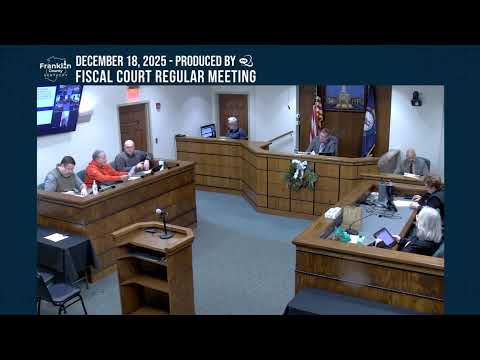
Sheriff Dwayne Depp told the Franklin County Fiscal Court on Dec. 18 that his office had expanded operational and community work in 2025, from criminal investigations that supported state and federal cases to outreach programs in schools and community events. He thanked the court for his appointment and introduced staff brought to the meeting as evidence of the office’s capacity.
The sheriff’s presentation included operational metrics: roughly 3,076 vehicle inspections and 10,768 calls for service to Dec. 15. Deputies served 3,337 summonses and processed 601 concealed-carry applications in the year to date. The Criminal Investigations Unit assisted the attorney general’s office and KSP on complex child‑abuse and homicide cases, and detectives participated on a DEA task force that coordinated multimillion‑dollar seizures and arrests in large federal operations.
The sheriff asked the court to authorize a higher sheriff fee budget for 2026. He said the proposed budget increase — from about $4,000,810 to $5,000,149 for the sheriff’s office — is to cover COLA, overtime costs and anticipated payouts tied to post‑election turnover. The court voted to approve the sheriff’s participation in the state advance program, which offers an interest‑free state advance of $400,000 to provide cashflow at the start of the year, and separately approved the sheriff’s annual order setting maximum pay amounts for deputies and assistants.
Members also heard about non‑patrol work the office provides: a full‑time traffic grant deputy funded through the Kentucky Office of Highway Safety, a deputy assigned to a multijurisdictional DEA task force, and school resource officers jointly supported with the Franklin County Public School System. Sheriff Depp noted partnerships with the county attorney’s office, local police, and several federal agencies as central to investigations and emergency response capacity.
The court approved the requested budget authorities and the sheriff’s annual order in a voice vote during the meeting’s voting session. The sheriff also described two operational increases to the annual order — a 3% COLA and additional payroll flexibility for overtime and potential payouts — that underpinned the requested annual order increase.
The court took no action to add general fund support; the sheriff indicated the increase would be funded from fees and revenues collected by the sheriff’s office rather than county general‑fund appropriations.
Looking forward, the sheriff highlighted community programs to be expanded in 2026, including a revived DARE program and an Eddie Eagle gun‑safety outreach effort in elementary schools. The presentation closed with an outline of flood‑response involvement and a neighborhood mailbox‑visibility campaign to help first‑responder access during emergencies.