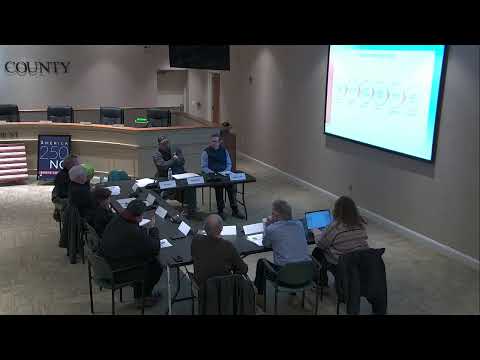
Staff: 53% of Burke County land is exempt or deferred, costing about $12 million a year
Loading...
Summary
A staff presentation showed roughly 53% of Burke County’s land is exempt or deferred from property tax, representing about $2.1 billion in assessed value and an estimated $12 million annually in lost revenue; the committee accepted the report unanimously and discussed outreach and audit steps.
A county presenter told a Burke County committee that roughly 53% of the county’s land is currently exempt or deferred from property tax, representing about $2.1 billion in assessed value and an estimated $12 million a year in lost revenue.
The presenter summarized map data showing taxable parcels in purple and exempt or deferred parcels in green and said, “Total exempt deferred value across the county is about $2,100,000,000 which results in a loss of Burke County revenue of roughly $12,000,000 a year that’s not taxed.” The map highlighted state and federal lands in South Mountain and Jonas Ridge and numerous nonprofits, churches and institutional properties inside the county’s developed areas.
Why it matters: county staff emphasized that the General Assembly — not local officials — controls which classes of property may be exempted. Speaker 1 explained that Article V of the North Carolina Constitution vests the authority to classify property and grant exemptions with the General Assembly and that local taxing authorities “may not grant exemptions” beyond those established by state law.
What was in the briefing: presenters reviewed several common programs that reduce the county tax base. - Elderly exclusion: eligibility requires age 65 and a 2026 income cutoff of $38,800 for single or married filers, according to staff. - Circuit breaker (deferment): created by the General Assembly around 2009, the program is a deferment rather than an exclusion; staff explained it provides relief for households whose incomes exceed the exclusion limit but still need assistance and that deferred amounts become liens recoverable on certain disqualifying events. For 2026, staff cited a 150% income threshold example (about $58,200). - Disabled veterans: staff said a certified 100% service‑connected disability (as certified by U.S. Department of Veterans Affairs as of Jan. 1) removes $45,000 from assessed value. - Present Use Valuation (PUV): agriculture requires a minimum 10‑acre tract in production and $1,000 average gross income over three years; horticulture requires a minimum 5 acres; forestry requires at least 20 acres with a certified forester management plan. Staff reiterated these enrollments are subject to recapture for the current year and three prior years if the property leaves the program or fails requirements.
County resources and impacts: staff noted roughly 90,000 acres in Burke County are government-owned and that the exempt/deferred total they presented is driving higher property tax rates for the remaining taxable base. A committee member used a local example: the cost of a fully equipped ambulance is about $240,000, a reminder of how exemptions affect the county’s purchasing power.
Compliance and outreach: staff said the county and state require periodic audits and that the county sends questionnaires to verify continued eligibility (for example, confirming seniors still occupy the residence). Presenters described outreach channels — the county website, listing abstracts sent to parcels in prior years and veteran service officers — and committee members urged more targeted outreach to veterans and senior centers.
Committee action and next steps: the committee motioned to accept the report as presented; the motion was seconded and the clerk declared the vote unanimous. Staff offered to distribute the PowerPoint to members and to provide materials that could be shared with veteran organizations and senior centers. The committee scheduled its next meeting for 2026-03-03 at 9:00 a.m.
The committee accepted the report and adjourned without further formal action.