Urbana police urge narrower surveillance definition as residents press for civilian oversight
Loading...
Summary
Residents urged the council to adopt a surveillance ordinance that limits harms and increases civilian control; Deputy Chief Micklew cautioned the current draft is broad, could capture routine investigative work, and would create substantial reporting and staffing needs.
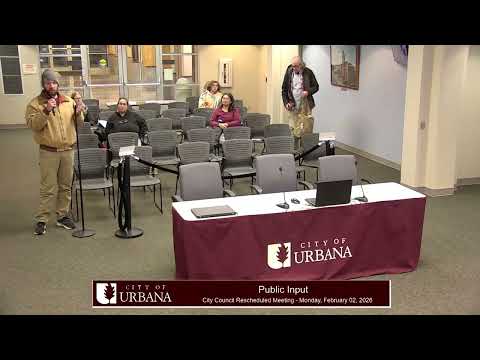
Urbana — Residents and police offered competing but not irreconcilable perspectives on a proposed city surveillance ordinance during the Urbana City Council meeting on Feb. 2, 2026.
Bridal Leopold, a Ward 4 resident, told the council she supports an ordinance that would carefully define and limit surveillance technology use to avoid “unintended consequences” for residents. “I really, really support having an ordinance like this because so much of what we’re using wasn’t, you know, designed by everyone in this community together,” Leopold said during public comment.
Resident Ben Jocelyn urged civilian control over surveillance tools and framed the proposal as part of broader public-safety and civil-rights concerns, saying investments in social supports should be prioritized over expanded police technology.
Deputy Chief Micklew of the Urbana Police Department presented operational concerns and recommended changes to the draft ordinance. Micklew said the department’s inventory intentionally used an expansive definition to be exhaustive, then urged the council to adopt a definition that distinguishes automated, persistent, programmatic surveillance from routine, case-specific investigative analysis. “It’s important to distinguish between technologies that actively gather new information and tools that analyze information we already have access to,” Micklew said, adding that some systems (for example, NCIC/Leads and Cellebrite) already operate under state and federal law and established policies and should not be treated the same as programmatic surveillance.
Micklew also raised the definition of exigent circumstances, arguing the ordinance’s current language aligns more with disaster response than the narrow, time-sensitive law-enforcement concept of exigency (life‑safety or immediate risk). He warned that routing exigent approvals through the mayor for time-sensitive incidents could slow response; instead he proposed retaining authority with the chief of police or designee for immediate cases and reserving mayoral approval for declared disasters.
On implementation, Micklew said compliance will create ongoing administrative and reporting work. He described a two‑phase implementation: Phase 1 to bring existing technologies into compliance (inventory review, drafting use and policy reports, internal coordination) and Phase 2 for ongoing obligations (annual reporting, tracking usage, updates). He estimated the work would require the department’s administrative staff, data analysts and “probably 2 or 3” professional staff to compile reports and that even under a narrower definition the department would likely need at least one full‑time position to sustain obligations.
Council members asked for clarifications and practical examples. Grace pushed back on treating investigative activity as surveillance and suggested some exigent circumstances language intended for disasters should instead be framed within individual technology use policies; she asked the department to provide a draft model use policy and any slides or materials. James and Mary Alice described instances where access to external systems (for example, university card readers) helped resolve missing‑person calls, underscoring the council’s concern about perhaps narrowing authority too far in time‑sensitive cases.
The presentation and discussion concluded with the council requesting Micklew’s slides, draft use‑policy language, and examples that differentiate investigative access from programmatic surveillance. No ordinance vote was taken; the council signaled it will continue refining terminology and operational details in future meetings.
Quote highlights from the meeting include Bridal Leopold urging a community‑crafted ordinance and Deputy Chief Micklew calling for a precise definition to avoid unintentionally regulating court‑authorized investigative activity.
Next step: council members asked the police department to provide draft use policies, the presentation slides and clearer proposed definition language for follow‑up consideration at a later meeting.