
Pataskala planning commission tables 89‑acre data‑center site plan after hours of public and commissioner questions
Get AI-powered insights, summaries, and transcripts
Sign Up Free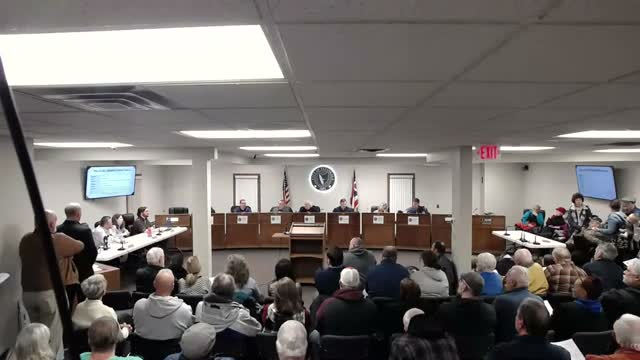
Summary
After a multi‑hour presentation and sizable public comment, the Planning & Zoning Commission voted to table PM25001, an applicant’s plan for four large data‑center buildings on about 89.4 acres, and asked the applicant to return with additional engineering, water, wetlands and utility permitting details.
The Pataskala Planning & Zoning Commission on Feb. 4 tabled a plan‑manufacturing application (PM25001) for an approximately 89.4‑acre data‑center campus after more than three hours of staff and applicant presentations, commissioner questions and dozens of public commenters.
City staff described the proposal as four large data‑center structures on the southeast corner of Broad Street and Mink Street, with associated utility yards, parking and two electrical‑utility areas expected to be designed by AEP. Staff said the parcel contains about 1.85 acres of wetlands and that some variances previously requested by the applicant had been withdrawn. Staff also noted remaining engineering items—grading/cross sections, interior screening and stormwater calculations—and that applicant‑requested electrical and fuel‑cell layouts would be submitted to the city administratively after a site‑plan approval and would also require state review where applicable.
The applicant, represented by Joseph Gidi and members of the Align team, walked commissioners through renderings, a berm and screening plan and technical summaries of operations. The applicant said the campus buildings measure roughly 945.5 feet by 184 feet (each) and include rooftop equipment screens and utility yards. Align described a closed‑loop cooling approach and provided its estimate of peak day water demand: “We expect a peak day, to be 12,000 gallons per day,” the applicant said during the presentation. Company representatives also described a planned mix of onsite generation and grid supply; in discussion they characterized the long‑term distribution as roughly 30% onsite generation from fuel cells and 70% from the grid at full campus build‑out.
Commissioners pressed the team on several points: whether data centers are explicitly permitted under the city’s 2007/2008 NAICS matrix; whether the large on‑site generation (the applicant identified Bloom fuel‑cell installations as the primary on‑site generator) would trigger state major‑utility or Ohio Power Siting Board review; the precise water‑use and waste‑water handling plans; fire‑department access and response time inside a secure facility; and whether approval of local zoning before a state utility permit would effectively lock in site configuration.
Resident testimony was lengthy and often critical. Speakers raised concerns about increased electric rates and who would bear the cost of the additional utility infrastructure, potential well and groundwater impacts, stormwater and downstream flooding, noise and low‑frequency sound, impacts to wildlife and wetlands, property‑value declines, and the community character of Pataskala. Several residents asked the commission to delay action or ask the city to pursue a moratorium until broader studies and clearer regulatory responses were available.
Commissioners and staff singled out several items they wanted addressed before further action: confirmation of the Army Corps/Ohio EPA wetlands delineation and any mitigation plan; validation and supporting documentation for the applicant’s peak water‑use figures from the local/regional water district; full stormwater and culvert/tributary recalculations and any recommended upsizing (commissioners noted the city’s public‑service staff saw tributary estimates that could understate flow); detailed fire‑department coordination (including access through security layers); and a clear statement of what design elements would be resolved at the state level (AEP and the Ohio Power Siting Board) versus what remains under local review.
After deliberation commissioners voted on a motion to table the application so the applicant and staff could respond to the list of deliverables. The motion passed on roll call; the commission recorded the tabling and asked staff and the applicant to return with the requested documentation and any AEP/Ohio Power Siting Board schedules or filings. The applicant said it would work with staff to provide those materials.
What’s next: PM25001 will return to the commission only after applicants submit the additional engineering, environmental and utility documentation requested by staff and commissioners. The city noted that any large‑scale electrical generation or major‑utility facility proposed on the site would require separate review by state regulators; that state approval had not been granted and remains a distinct process from this local land‑use review.
The meeting also moved other items on the agenda (see separate coverage); the PM25001 hearing was the night’s focal point and prompted the commission to request a formal package of deliverables before any further action.