
Mat-Su assembly hears options for AK LNG tax framework as municipalities press for PILT
Get AI-powered insights, summaries, and transcripts
Subscribe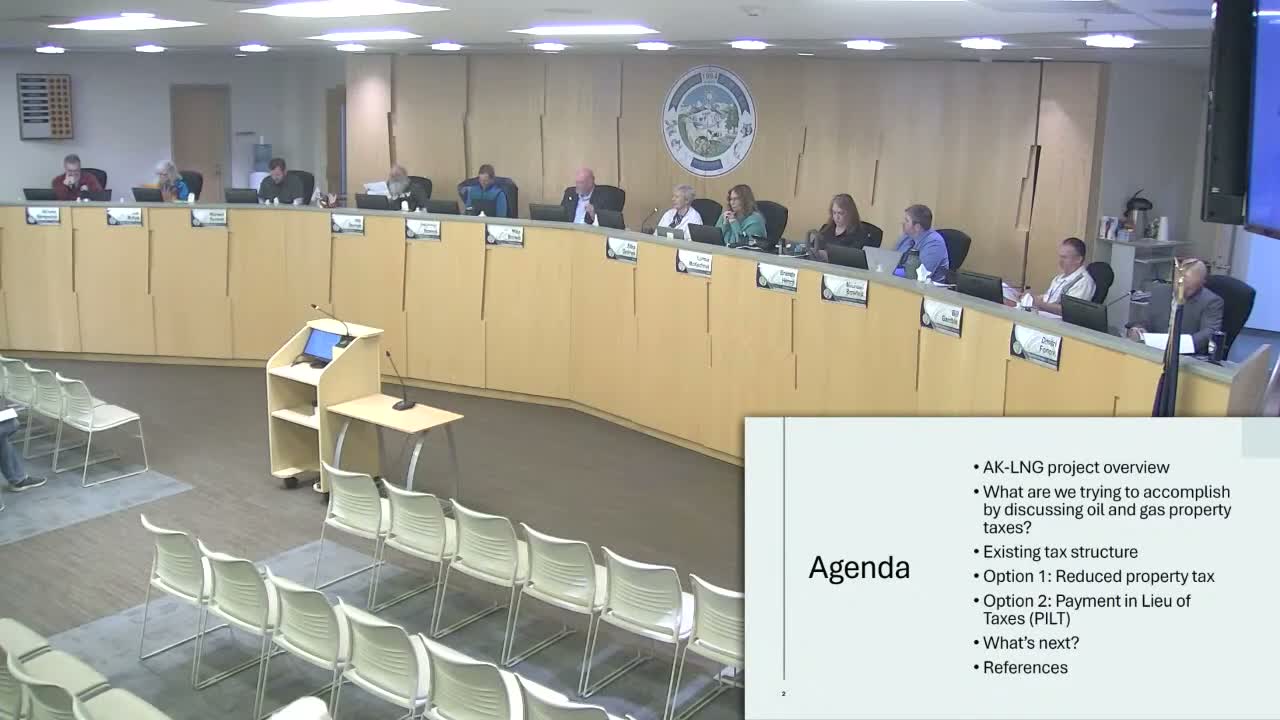
Summary
Manager Brown and AGDC representatives briefed the Assembly on competing tax options for the AK LNG project — a lower '2-mill' property tax or a volume-based payment-in-lieu-of-taxes (PILT). Officials said revenue modeling shows a full property-tax assessment could generate roughly $760 million annually on the entire project value; a throughput PILT would yield smaller, more predictable initial payments for the borough.
Manager Brown and state pipeline partners laid out competing ways to tax the proposed Alaska LNG project, saying the Assembly should weigh whether the borough supports a property-tax approach or a payment-in-lieu-of-taxes tied to pipeline throughput. Brown told the Assembly the borough is starting the conversation because state legislation is expected soon; he said an immediate choice will affect both the project's economics and local school funding calculations.
“if you apply the current tax structure, that would be approximately $760,000,000 annually,” Manager Brown said, describing the impact when the project's roughly $44 billion valuation is included in existing property-tax math. Brown said the Mat-Su portion of the route represents about $3.2 billion in value and that unmitigated inclusion of that value in the borough tax base could alter required local contributions to education funding.
Frank Richards, president of the Alaska Gas Line Development Corporation (AGDC), spoke with the Assembly about schedule, consumer rates and how tax design affects affordability. Richards said the developer is targeting a final investment decision this spring: “they have been working diligently ... toward a final investment decision this spring,” he said, and noted that some construction procurement is already underway. Richards gave examples of potential consumer pricing and the role of the Regulatory Commission of Alaska in reviewing rates.
Two models were highlighted for local consideration. Option 1 would amend property tax rules to apply a smaller rate (examples given ranged to a 2-mill rate), providing a predictable, assessment-based revenue stream but raising valuation and litigation risks. Brown said a modeled 2-mill tax could generate roughly $4 million annually for the Mat-Su Borough. Option 2 — the throughput PILT recommended in the draft resolution introduced tonight — ties payments to pipeline volume, shares project risk between government and developer, and avoids annual valuation litigation; an example throughput PILT of six cents per thousand cubic feet was modeled to yield about $3 million per year for the borough initially.
Brown and Richards urged assembly members to weigh tradeoffs: a property-tax approach gives a direct share of nominal project value but risks large, volatile swings in assessed value and potential court challenges; a throughput PILT is more predictable for the project and avoids immediate valuation disputes but delays or reduces revenue if export volumes are low in early years. Brown said a draft resolution in the packet recommends the throughput PILT option and will return for a public hearing on Feb. 17.
The Assembly asked whether the proposed tax design would affect in-state gas prices and school funding formulas; Richards answered questions on commercial assumptions and RCA oversight of final retail rates, while Brown said staff will work to calculate how different scenarios affect the borough’s school funding contribution. The Assembly did not take action tonight beyond introducing the resolution and scheduling a public hearing.
What happens next: Resolution 26-009 recommending a throughput PILT was introduced and scheduled for public hearing Feb. 17; Assembly members asked staff to provide additional modeling on school funding impacts if the pipeline valuation is included in borough totals.