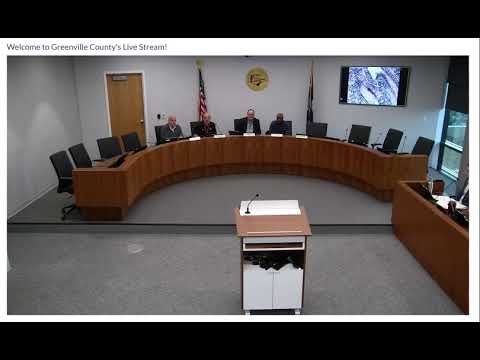
Greenville County attorney warns proposed Article 3.1 LDR language risks legal challenge; staff to produce draft by March
Loading...
Summary
The county attorney told the Planning & Development Committee that proposed Article 3.1 language, which borrows broadly from state intent language, risks being unconstitutionally vague and hard to defend in court; staff will draft a more precise version for the March meeting.
Greenville County's acting county attorney told the Planning and Development Committee on Feb. 2 that a proposed amendment to Article 3.1 of the county Land Development Regulations (LDR) must be rewritten to avoid constitutional due-process pitfalls and the vagueness doctrine.
"Procedural due process ... requires that we provide the ordinance itself ... so that people have fair notice what they can or cannot do," Speaker 4, the county attorney, said during a detailed review of legal standards. He cautioned that language drawn directly from state statute listing general legislative purposes—public health, safety, economy, appearance and welfare—reads as aspirational and may not provide a court-enforceable standard.
The attorney told the committee that the state provision most often cited in this context, South Carolina Code section 6-29-11-20, sets legislative intent but does not itself supply the granular, enforceable criteria a court would expect. "If it forbids or requires the doing of an act in terms so vague that a person of common intelligence must necessarily guess as to its meaning," he said, "then it's unconstitutionally vague."
Committee members pressed on how to give planning commissioners usable discretion without inviting successful legal challenges. Some members said they want tools to address traffic, road capacity and other community impacts that are difficult to capture with purely mechanical checklists. One member noted past litigation tied to a previous 3.1 version; Speaker 4 said the earlier version failed in part because it lacked concrete criteria and careful documentation of findings.
The attorney recommended several steps: draft enforceable standards rather than relying solely on intent clauses; provide staff and planning commission training so decisions generate a clear record; and research other jurisdictions' approaches and relevant case law to build defensible language. He emphasized the need for objective or repeatable grounding—traffic studies, engineering thresholds, or other tangible metrics—so decisions are not reduced to "vibes."
Council members also raised operational options, including using zoning or LDR tools in unzoned areas and setting tangible thresholds (for example, road width or required access points) where engineering analysis supports them. Speaker 4 said some of those questions are technical rather than purely legal and recommended collaboration between legal staff, planning staff and council members.
The committee agreed to keep the discussion in the P&D committee and Speaker 4 committed to provide a draft for the first P&D meeting in March to begin shaping a version that balances local policy goals with legal defensibility. The item remains in discussion; no ordinance text was adopted at the Feb. 2 meeting.