Get Full Government Meeting Transcripts, Videos, & Alerts Forever!
Get email alerts on the Digital Equity Dashboard topic
No spam. Unsubscribe anytime.
Hawaii challenge seeks a near‑real‑time digital equity dashboard to track state progress
Summary
State digital equity officials invited Hawaii Annual Code Challenge participants to build a near‑real‑time dashboard to measure progress on the state digital equity plan and the Aloha Plus Challenge, citing federal funding and a roughly five‑to‑seven‑year implementation window.
At the Hawaii Annual Code Challenge, Bert Lam, State Digital Equity Coordinator at the Hawaii Broadband and Digital Equity Office in DBEDT, and Jillian Cristobal, dashboard coordinator with Hawaii Green Growth, asked attendees to help build a near‑real‑time digital equity dashboard to track the state’s digital equity plan and the Aloha Plus Challenge.
The dashboard is intended to give policymakers, community stakeholders and the public a clearer picture of progress and gaps. Lam said federal investment is now funding broadband and related programs across the state and that Hawaii has completed a digital equity plan; the dashboard would help identify underserved "covered populations," allocate resources and evaluate program effectiveness.
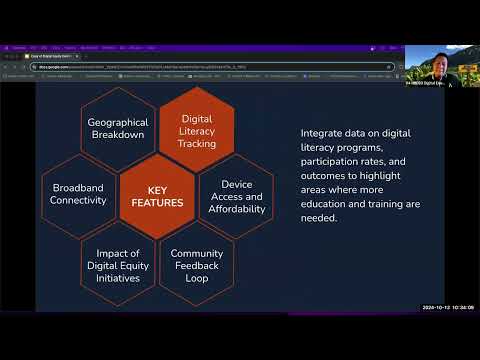
Lam outlined five core areas the dashboard should measure: internet access, digital literacy skills, device access, affordability programs and digital navigators. "We'd like to see how we could develop a dashboard that could be accessible to policymakers, community stakeholders, the general public, and enable them to kind of get a good understanding of the progress that we're doing, to, kind of close the digital divide," he said.
Jillian Cristobal described the technical approach used for Hawaii’s Aloha Plus Challenge scorecards and said the team primarily uses Esri mapping and hub site tools to display goal pages and scorecards. She said the Aloha Plus Challenge dashboards tie local goals to the United Nations Sustainable Development Goals and that the digital equity dashboard could be built as its own page with embedded visualizations. "Our dashboard, the Aloha Plus Challenge dashboard, is the main tool for tracking Hawai'i's progress towards the Aloha Plus Challenge," Cristobal said.
Presenters said expected hack outcomes include a clear, user‑friendly interface; tools to identify critical gaps in digital literacy and device access; and mechanisms to foster transparency and community engagement. Cristobal noted the platform can be low‑code or highly customizable and that other platforms are welcome if the result can be embedded in the state’s open data portal.
Lam emphasized timeline and workforce implications, saying the federal program creates "probably a good 5 to 7 year window" for implementation and that the effort could create job and capacity‑building opportunities across the state. He encouraged participants to join the project Slack channel and said slides and resources would be posted there; presenters also planned to be available later that afternoon for questions.
No formal votes or policy actions were taken during the presentation; the organizers framed the session as a request for project proposals and technical collaboration. The presenters said they will provide resources and further guidance on Slack and during follow‑up conversations.