Get Full Government Meeting Transcripts, Videos, & Alerts Forever!
Get email alerts on the Parks topic
No spam. Unsubscribe anytime.
Issaquah launches multi‑month rewrite of municipal park rules, seeks equity input and state alignment
Summary
Parks staff outlined a plan to update IMC park rules last amended in 1985/2000, solicit Park Board and public input through May, and align local rules with any enacted state legislation such as HB 2489 before final Council consideration this summer.
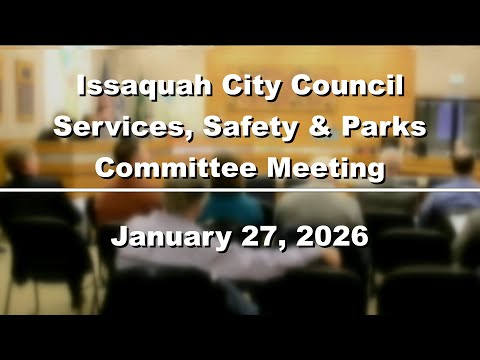
Parks Director Jeff Wadley told the Services, Safety and Parks Committee that the city will begin a multi‑month review and update of park rules in Issaquah Municipal Code Title 9 to better reflect modern park and trail uses and to provide clearer, codified standards for signage and enforcement.
Wadley noted that IMC 9.25 was last updated in 1985 and IMC 9.26 in 2000 and said many current and emerging park uses are not adequately addressed. "These next two months, February and March, we'll be digging in a little deeper with the Park Board," he said, describing a process of public outreach, benchmarking and drafting in April–May with the goal of a Park Board recommendation in May and Committee consideration in June.
Topics staff flagged for review include rules on sales and concessions (including food trucks), permits and field rentals, motor vehicles and parking, animal/pet rules, trail use, tents/shelters/camping, swimming and water access, drones/remote control models, fireworks/weapons, amplification, litter and dumping, solicitation, and use of tobacco/alcohol/controlled substances.
Council members raised the pending state bill HB 2489 (related to camping) and asked whether the city's timeline and Park Board engagement should adjust if the state law preempts local rules. Wadley said staff and the city attorney are tracking the legislation and will ensure local rules are consistent with any state changes. Council asked that Park Board work include an equity lens and a review of neighboring jurisdictions' best practices.
Next steps: staff will coordinate Park Board meetings and public outreach in February–May, seek a Park Board recommendation in May, and return recommended code changes to the committee in June with a timeline to full Council adoption and summer implementation.
Ending: Committee members offered technical help (for example, on drones) and asked staff to ensure transparent public engagement and benchmarking with peer cities.