
Planning commission approves county-initiated traffic map update, 4–2
Get AI-powered insights, summaries, and transcripts
Subscribe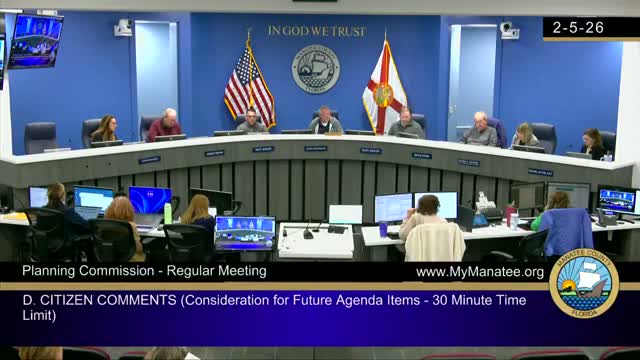
Summary
The Manatee County Planning Commission voted 4–2 to approve a county‑initiated comprehensive plan text amendment to update the Map 5 series and Table 5‑1 (traffic level‑of‑service) to reflect current and 2050 roadway conditions and add context classifications and trail maps; the measure will go to the Board of County Commissioners for hearings.
The Manatee County Planning Commission on Feb. 5 approved a county‑initiated comprehensive plan text amendment (PLN2510‑0080) to update Chapter 5's traffic subelement, Table 5‑1 (peak‑hour level‑of‑service standards) and the Map 5 series that portray existing and future arterials and rights of way.
Senior planner Elizabeth Schulman told the commission the amendment adds the statewide Sun Trail network and the Manatee County Trailways Master Plan to the map series, updates the planning horizon from 2045 to 2050 and introduces FDOT‑supported ‘context classification’ categories (C1–C6) to guide future roadway design. “The context classification identifies users, land use and environment and will inform roadway design standards,” Schulman said.
Public commenters had pressed the commission on other topics before the vote. Terracea Island residents and conservation advocates asked commissioners to defend existing comprehensive‑plan protections and warned a proposed cruise terminal would be incompatible with the Terracea Aquatic Preserve and local residential uses. Jeff Click, a Terracea resident, said threats toward county employees are unacceptable and urged lawful civic engagement. “That behavior is not condoned or supported,” Click said.
Commissioners debated whether to delay the update pending action on state bills (including SB 180 and SB 250) that affect downgrades of roadway classifications. Poni Boniface, staff transportation analyst, said existing level‑of‑service data are maintained monthly and the amendment does not change County policy standards; it updates maps and tables used daily by staff. “This table is one of the important tools staff uses; it needs to be up to date and timely,” Boniface said.
The commission approved the ordinance language and recommended the amendment move forward to the Board of County Commissioners. The vote was 4 in favor and 2 opposed. Commissioners requested additional workshops and clearer communications about how the maps, the link‑sheet data and peak‑hour assumptions relate to project‑level traffic studies.
Next steps: the ordinance and map updates will be scheduled for transmittal hearings before the county commission, where the body will consider adoption hearings and any responding amendments.