
Senate committee hears testimony on bill to make financial education a high‑school graduation requirement
Get AI-powered insights, summaries, and transcripts
Subscribe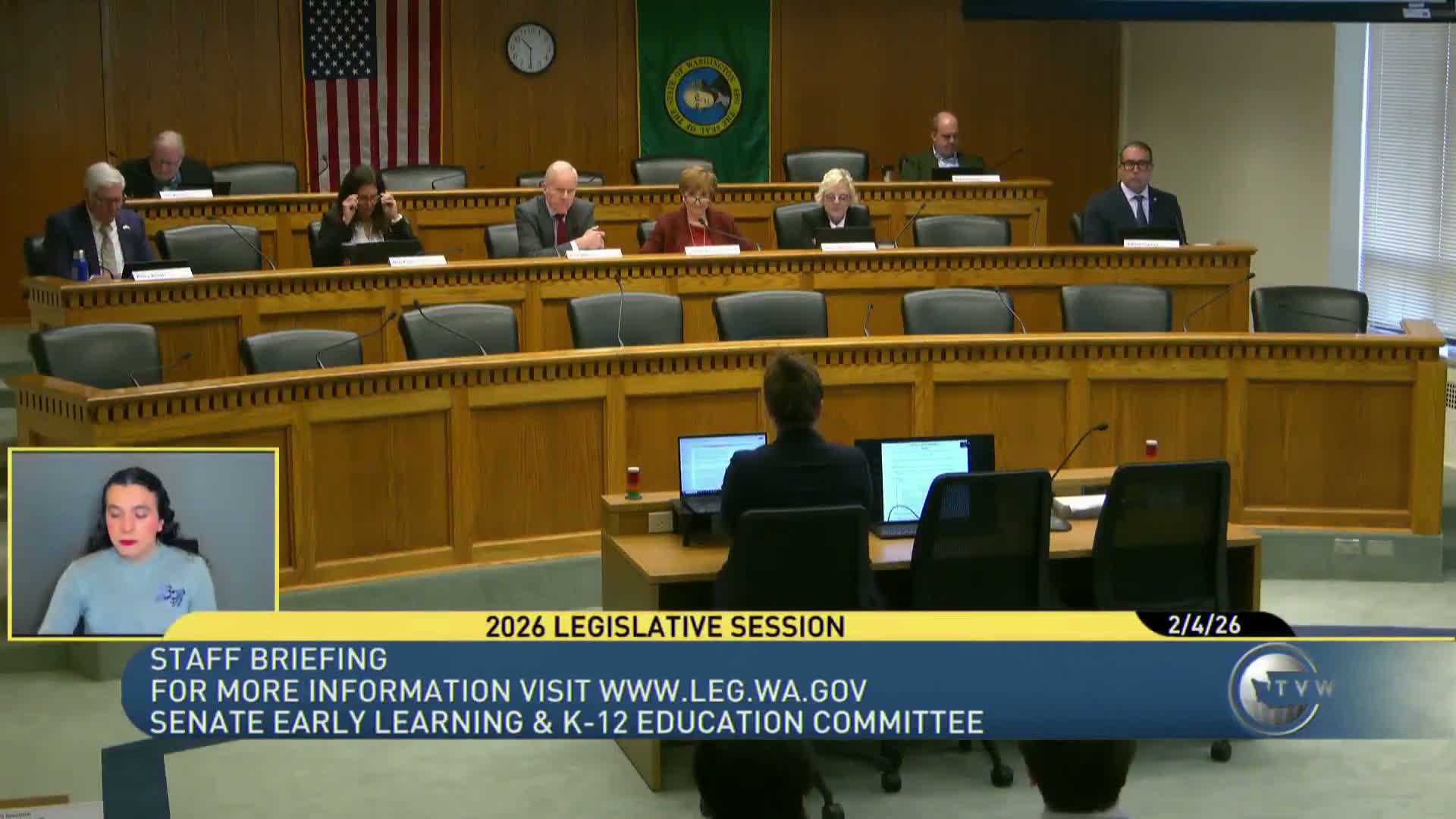
Summary
Senate Bill 58‑49 would require all Washington high‑school students to meet state financial education standards to graduate, starting with instruction in 2029–30 and a graduation requirement for the class of 2033; supporters cited equity and student readiness while school leaders warned of an unfunded mandate and staffing constraints.
Senate Bill 58‑49 would make financial education a high‑school graduation requirement in Washington, the Early Learning & K–12 Committee heard on Feb. 5.
Elena Becker, committee staff, told the committee the bill requires school districts, charter schools and state tribal compact schools to provide financial education instruction consistent with OSPI’s learning standards and requires students to meet those standards to graduate. Becker said the graduation requirement would begin with the class of 2033 and that districts are directed to start offering instruction in the 2029–30 school year. She also said a fiscal note released the morning of the hearing estimated roughly $201,000 in state costs over a four‑year outlook and that additional district costs are indeterminate pending State Board of Education implementation choices.
The bill directs the State Board of Education to work with stakeholders to recommend how to incorporate the requirement into existing graduation pathways and to report to the Legislature by December; the bill language, Becker said, also tasks SBE with ensuring district compliance.
Supporters urged the committee to advance the measure. Conrad Kroll, a Bellevue High School student and founder of Westbank Financials, said many senior students are unprepared for basics such as budgeting and investing and argued a mandate is necessary because “financial literacy is something that…is currently being underemphasized.” Natalie Veil O’Neil, CEO of Junior Achievement of Washington, said Junior Achievement delivered more than 400,000 hours of financial literacy instruction to roughly 60,000 students statewide last year and argued SB 58‑49 would make instruction consistent and equitable across zip codes. Christy Johnson, a nonprofit chair and educator, described an ongoing transfer of wealth and said ensuring students have financial skills is urgent for economic opportunity.
Several district leaders and school directors urged caution. Sandy Hayes, speaking for the Washington State School Directors Association, said districts share the goal of financial literacy but warned that instructional time and staffing are limited and that the state should not add requirements without removing or funding others. Jay Tias, a superintendent, said smaller and rural districts are already “completely tapped out” and asked whether the Legislature would provide a funding line or additional staff to implement the change.
Committee members pressed staff and the sponsor on implementation details. Senators asked whether the requirement would expand credits in some district scheduling models, how the State Board would incorporate the requirement into competency‑based or alternative pathways, and whether teacher‑preparation programs—PESB—would be involved in readying educators; staff said the bill directs SBE to assess incorporation and that she would follow up about PESB references.
No formal committee vote on SB 58‑49 is recorded in the hearing transcript; the committee closed public testimony and moved into executive session to consider separate packets of bills.
Next steps: the bill remains at the committee stage with staff and sponsor questions about alignment, teacher preparation and district fiscal impacts to be clarified before final action.