Get Full Government Meeting Transcripts, Videos, & Alerts Forever!
Get email alerts on the Higher Education topic
No spam. Unsubscribe anytime.
Committee hears students and colleges urge restoration of aid for private nonprofits
Summary
Students, private‑college leaders and health‑care educators told the House Postsecondary Education & Workforce Committee that recent cuts to Washington College Grant and College Bound Scholarship awards for students at private nonprofits risk enrollment, graduation and state workforce pipelines; sponsors urged restoring parity while lawmakers pressed for data on affected students.
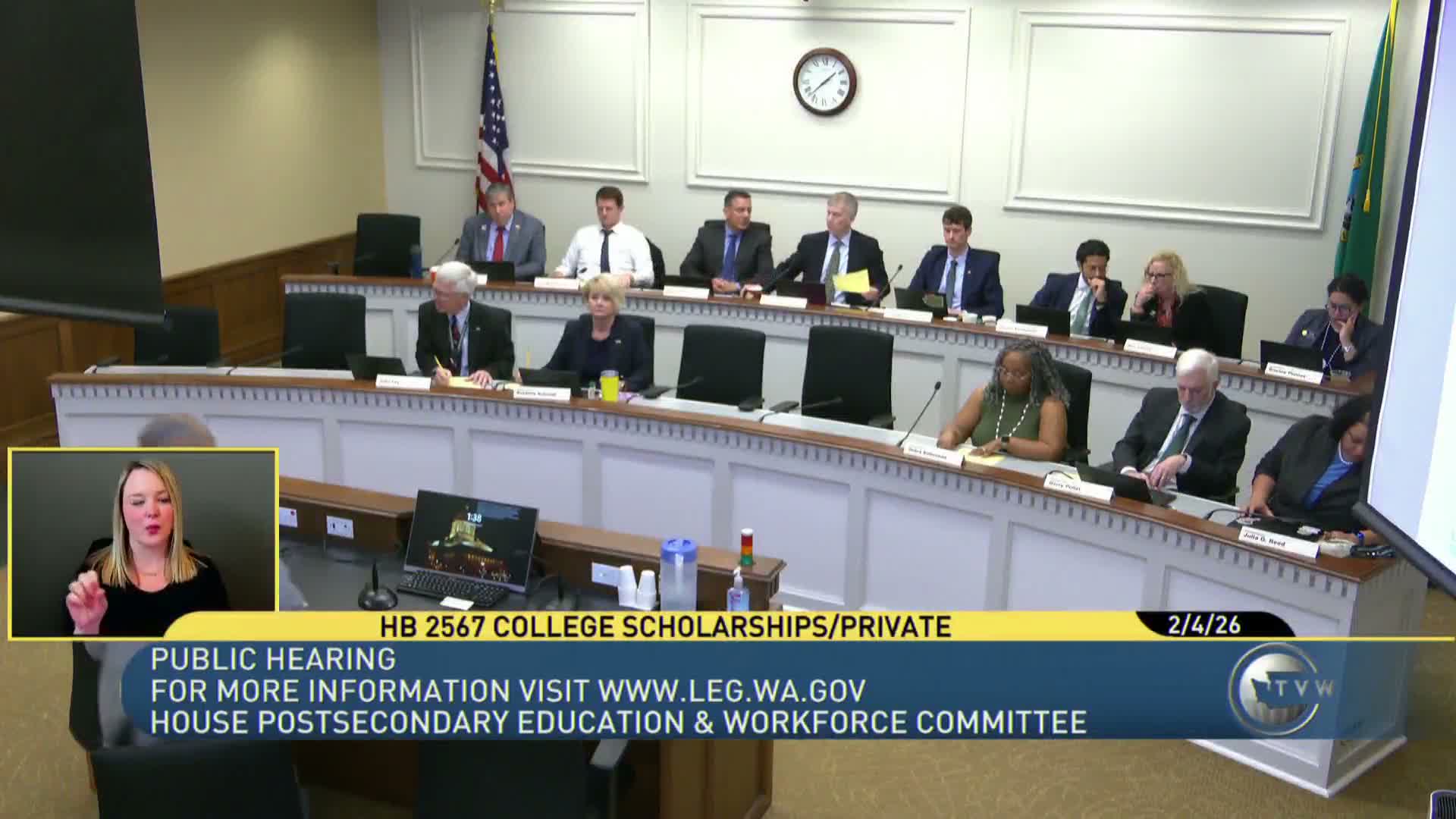
House Bill 25‑67 drew more than 1,500 public sign‑ins and a steady stream of student and institutional testimony on Feb. 4, as witnesses urged lawmakers to restore Washington College Grant and College Bound Scholarship award levels for students attending four‑year private nonprofit institutions.
The bill, presented to the House Postsecondary Education & Workforce Committee by counsel Saranda Ross, would modify maximum award amounts so that students attending private nonprofit four‑year colleges receive awards comparable to the average award at the state’s public research universities. Ross told the panel the change would apply beginning in the 2026‑27 and 2027‑28 academic years for the college grant and college bound scholarship respectively.
Sponsor Rep. Paula Street (37th District) framed the bill as a restoration of a promise to low‑ and middle‑income students, noting last session’s cuts specifically reduced awards for students attending private nonprofits. “This is about honoring our promise and restoring access for students who chose a private institution that best fits their needs,” Street said.
Students from multiple campuses described immediate impacts. Josiah Tiblo, student senator at Saint Martin’s University, said roughly 47% of his campus relies on WCG/College Bound aid and estimated some students could lose up to about $10,000 a year under anticipated cuts. Mercedes Garcia, student‑government president at Heritage University, said 88% of Heritage students rely on financial aid and warned that cuts would push students to work more, delay graduation or drop out.
Institutional leaders also pressed the committee. Alan Belton, president of Pacific Lutheran University, told lawmakers the cuts “shift the entire fiscal burden to one specific group of students,” and said reductions on the order of thousands of dollars annually have disproportionate effects on first‑generation and students of color. Catherine Mahoney, representing independent colleges, emphasized that the funding supports students rather than institutional operating budgets.
Committee members asked for data to assess tradeoffs. Ranking member Ibarra suggested an across‑the‑board small reduction might preserve choice for all students; Rep. Street and witnesses said they would consider equity tradeoffs but urged an analysis of student counts and impacts before recommending changes. Staff and institutions agreed to follow up with requested transfer and eligibility data.
Why it matters: supporters argue restoring parity preserves student choice, supports diverse pipelines (including health professions), and keeps students in Washington communities. Opponents or skeptics at the hearing focused on budget tradeoffs and the need for precise counts on how many students would benefit under alternate proposals.
The committee concluded the public hearing on HB 25‑67 with no formal action today. The bill may return for further consideration with budget details and supplemental data from colleges.