State broadband director outlines BEAD awards, technology mix and permitting plan

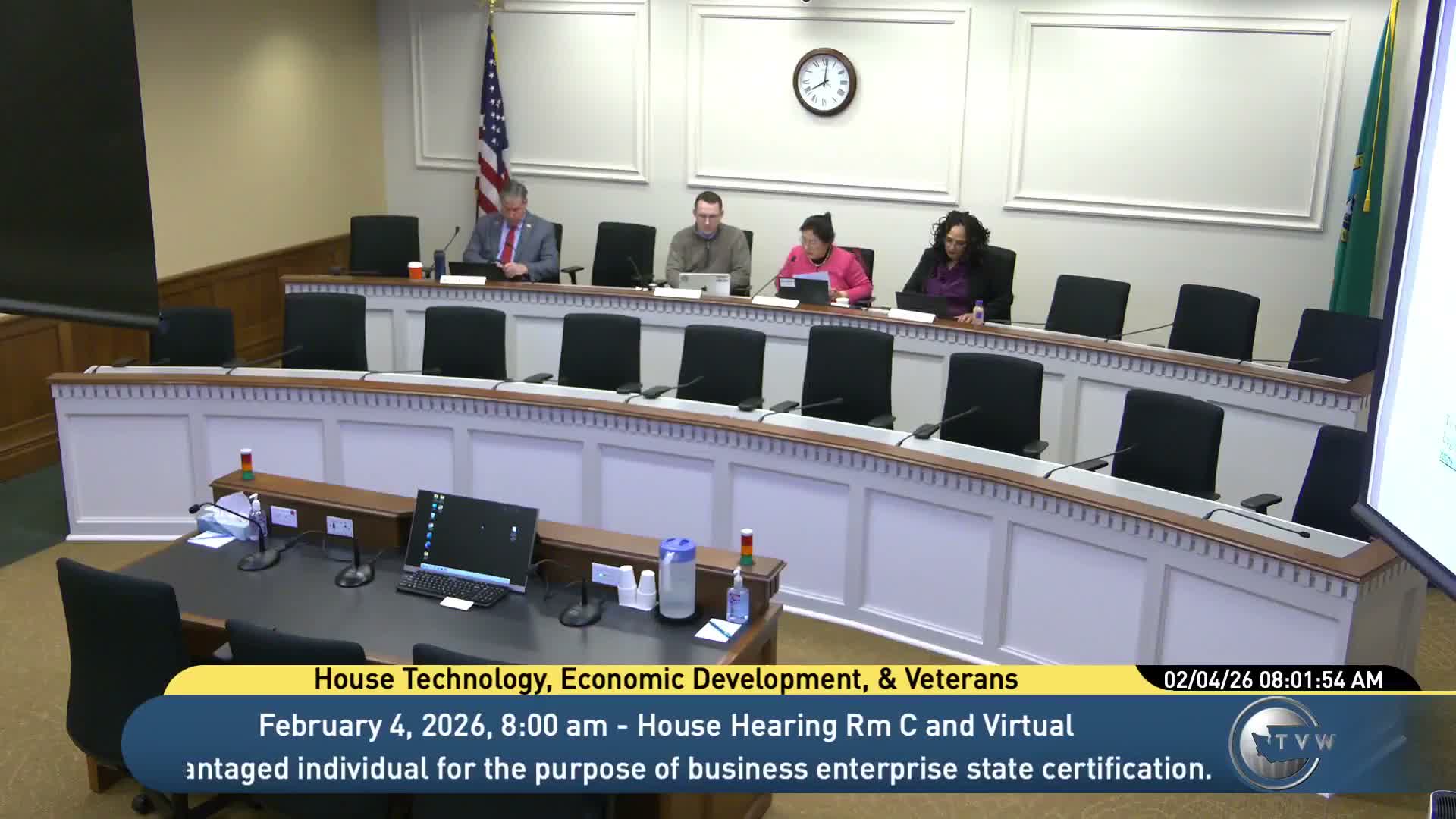
Washington State Legislature — Technology, Economic Development, and Veterans Committee · February 4, 2026

Get AI-powered insights, summaries, and transcripts

Subscribe
AI-Generated Content: All content on this page was generated by AI to highlight key points from the meeting. For complete details and context, we recommend watching the full video. so we can fix them.

Summary

Jordan Arnold, director of the Washington State Broadband Office, told the Technology, Economic Development and Veterans Committee that Washington’s provisional BEAD awards would connect about 166,000 locations, that $736 million of federal BEAD funds are currently available for deployment, and that WISBO is pursuing permitting roundtables and NEPA expertise to accelerate builds.

Jordan Arnold, director of the Washington State Broadband Office, told the Technology, Economic Development and Veterans Committee on Feb. 4 that Washington is prepared to move quickly once the National Telecommunications and Information Administration (NTIA) approves the state’s final BEAD (Broadband Equity, Access, and Deployment) proposal.

Arnold said the program will “connect 166,000 homes and small businesses in Washington,” and described a provisional technology split of roughly 35% fiber, 38% fixed wireless and 27% low Earth orbit (LEO) satellite for the locations the BEAD awards target. He told the committee the provisional awards are still contingent on NTIA sign-off.

Why it matters: BEAD is a once-in-a-generation federal investment intended to close broadband gaps. Arnold said the project portfolio represents the largest broadband infrastructure investment in Washington state history and that subgrantees are anxious to begin work because of construction seasons, equipment lead times and subcontracting needs.

Key numbers and constraints: Arnold said the state’s deployment-eligible federal BEAD funding for Washington stands at $736,000,000. He added private matching commitments of about $163,000,000 and a state match of about $112,000,000 for public entities (PUDs, ports, cities, counties and tribes). He also said construction funded under subgrantee agreements must be completed within four years of contract signature and that the federal interest period for BEAD investments covers 10 years.

Permitting and environmental review: Arnold identified two permitting tracks that affect schedules: easements/rights-of-way (access to poles, towers, highway crossings and private lands) and environmental and historic preservation (EHP) reviews led by NEPA or analogous state reviews. "Our north star is to get broadband permits issued or denied within 90 days," Arnold said, describing a goal rather than a statutory requirement.

To reduce delays, WISBO plans to convene multi-agency permitting roundtables—regular working groups of federal, state, local permitting authorities, landowners and subgrantees—to resolve project-specific sticking points. Arnold also said WISBO is hiring NEPA specialists to support subgrantees in preparing environmental documentation and will leverage federal tools such as categorical exclusions where projects do not cause significant environmental impacts.

Questions from legislators: Committee members asked whether state reviews (SEPA) would be required in addition to NEPA; Arnold replied that SEPA and other state-level reviews will be followed where applicable and explained that NEPA can be used as an "umbrella" to coordinate other statutory requirements such as the Endangered Species Act and the National Historic Preservation Act. Members also pressed on the drop from an earlier federal estimate to $736 million of deployment funding; Arnold said negotiations with NTIA about allowable technologies and costs reduced the portion of federal dollars the state can currently apply to deployment, but that the state's overall statutory allocation remains intact for other permitted uses.

What’s next: Arnold said WISBO has submitted a resubmission to NTIA (the most recent on Jan. 9), has answered about 25 formal NTIA requests, and that the office is preparing subgrantee agreements and permitting processes so work can start as soon as NTIA approves the final proposal.

The committee’s review continued in executive session on unrelated bills; no final NTIA approval date was provided during the meeting.